Cutting Thick Plate for Heavy Frames: Plasma, Oxy-Fuel or Laser
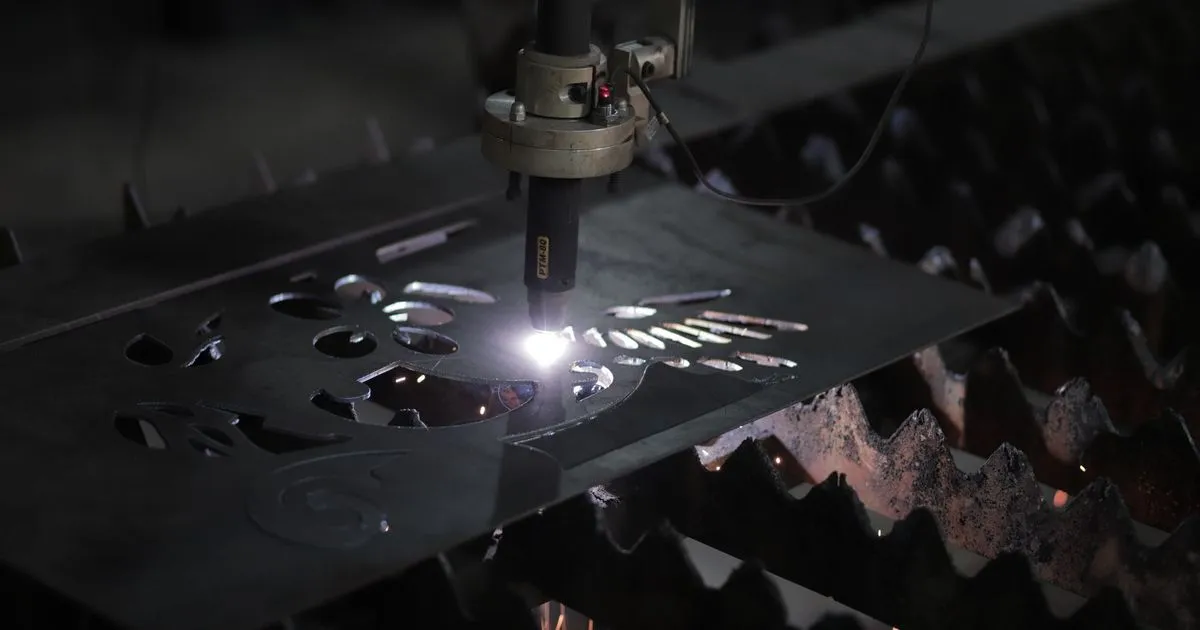
Every heavy frame starts as flat plate, and the first decision a shop makes is how to cut it. That decision is rarely written on the drawing. It is made at the quoting desk, based on which machines are free and which process is cheapest for the thickness. Most of the time the choice does no harm. Sometimes it leaves a hardened edge, a bevelled face or a nitrided surface in exactly the place where a critical weld will land.
This article compares plasma, oxy-fuel and laser cutting on plates from about 20 mm to 150 mm thick, explains what each process does to the edge, and lists the few things worth specifying so the cut does not become a quality problem later.
What each process does to the plate
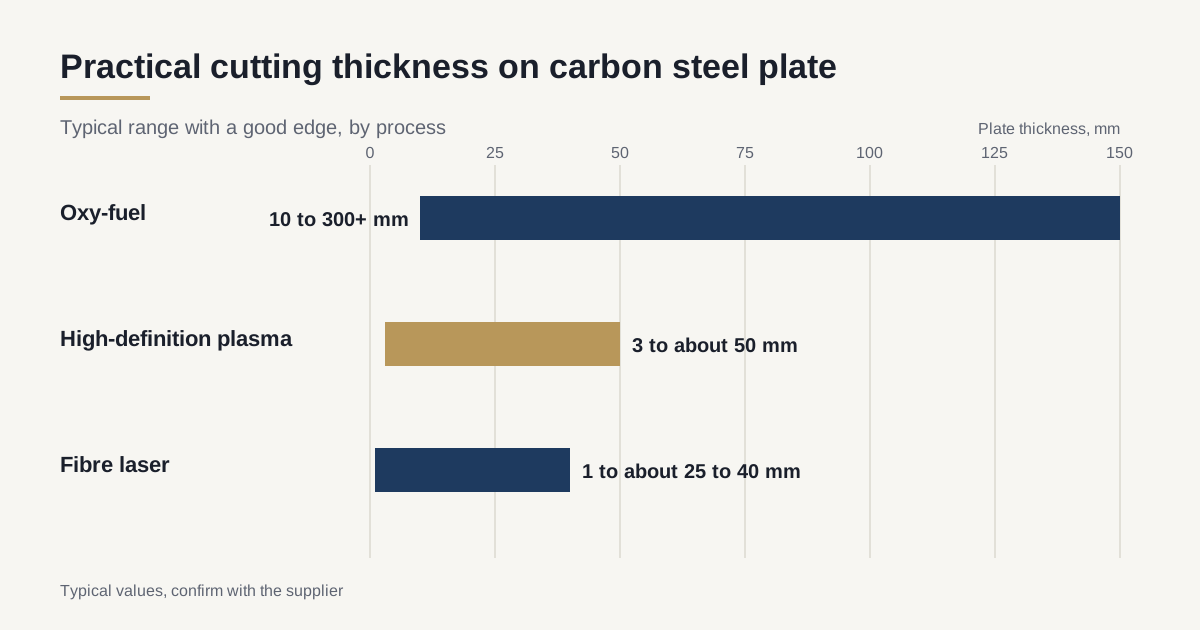
Oxy-fuel cutting burns the steel. A preheat flame brings a spot to ignition temperature, a jet of pure oxygen oxidises the iron and the molten oxide is blown out of the kerf. It only works on carbon and low-alloy steel, because the process depends on iron oxidising faster than the surrounding metal melts. Stainless steel and aluminium cannot be cut this way. Its great strength is thickness: the same torch principle works from 10 mm to well over 300 mm with the right nozzle and gas pressure.
Plasma cutting melts the steel with a constrained electric arc and blows the melt out with a high-velocity gas. It cuts any conductive metal, which makes it the default for stainless and for mixed-material jobs. High-definition plasma gives good edges up to roughly 25 to 50 mm. Above that, quality drops and the cut face tends to lean away from square. Shops with high-amperage systems sever plate well beyond that, but the edge is then a rough-cut edge.
Laser cutting melts or burns a very narrow kerf with a focused beam. On thin and medium plate it gives the best edge and the tightest tolerance. On thick plate it becomes slow and expensive per metre, and few machines handle thicknesses above 25 to 40 mm on carbon steel. For most heavy frames, laser is the process for brackets, small gussets and thin skins, not for the main plate.
Typical comparison on carbon structural steel
| Property | Oxy-fuel | Plasma (high definition) | Fibre laser |
|---|---|---|---|
| Practical thickness, carbon steel | 10 to 300 mm and above | 3 to about 50 mm for good edge | 1 to about 25 to 40 mm |
| Materials | Carbon and low-alloy steel only | Any conductive metal | Most metals |
| Typical kerf | 1.5 to 3 mm | 3 to 5 mm | 0.2 to 0.6 mm |
| Edge squareness on thick plate | Good | Leans, often 1 to 3 degrees | Very good on thin plate |
| Heat-affected zone | Widest | Medium | Narrowest |
| Speed on 25 mm plate | Slowest | Fast | Fast on thin, slow on thick |
| Cost per metre on thick plate | Lowest above 50 mm | Lowest at 12 to 40 mm | Highest on thick plate |
These are typical figures, not promises. Machine age, nozzle condition, gas quality and operator skill move every number in the table. Treat them as a way to judge whether a quote makes sense.
Edge condition and what it does to the next step
The cut edge is not just a boundary. It is a thin layer of steel that has been through a thermal cycle of its own, and the next operation inherits it.
Hardened edge. Steel with higher carbon equivalent can harden at the cut face because the plate cools quickly behind the flame. A thin hard layer can crack under weld shrinkage or machining. Preheating the plate before cutting, slowing the cut speed and grinding the face before welding are the usual remedies. Heavier plate and higher grades need more attention. The related issue of controlling preheat on the weld itself is covered in the article on welding distortion control for heavy plate.
Nitrided or oxidised surface. Plasma cutting with nitrogen or air as the plasma gas can leave a nitrogen-rich layer on the cut face. Welded over without cleaning, it can cause porosity. Oxy-fuel leaves an oxide scale that must be removed before welding. In both cases the fix is the same: grind the face back to bright metal on any edge that will be welded.
Bevel angle. Plasma cuts on thick plate are not square. A face that leans 2 degrees on a 40 mm plate moves the edge by about 1.4 mm from top to bottom. That matters for a fit-up with a tight root gap and for any edge that will be machined to a datum. If a joint needs square edges, either specify a second pass, machine the edge or use oxy-fuel.
Roughness and drag lines. Codes limit the roughness of thermally cut edges, and the limit depends on the thickness and on whether the part is fatigue-loaded. AWS D1.1 and EN 1090-2 both address cut-edge quality. If the structure is fatigue-loaded, confirm which class applies before the shop quotes.
Beveling and weld preparation
Weld joints on thick plate need a groove. Shops can cut the bevel in the same pass with a tilting torch head, or machine it afterwards. Oxy-fuel is common for bevel cutting on plate above 25 mm because multiple torches can cut a double-V in one run. Plasma bevels are faster but have more variation in angle and land.
Typical practice is to cut the bevel slightly full and then grind or machine to final profile where tolerances are tight. The fabricator should not guess the groove: it comes from the welding procedure. If the procedure changes, the bevel changes. A buyer who has not seen the weld procedure cannot judge whether the bevel is right, which is why reading it comes before ordering. See the guide to the AWS D1.1 weld standard for structural frames.
Distortion, nesting and plate utilisation
Cutting thick plate releases rolling stress. A plate cut into long narrow strips can bow or sweep as the stress redistributes, and a rectangle cut out of the middle of a plate can spring. Good shops cut in a sequence that keeps the plate balanced, leave bridges or tabs until the end and sometimes stress-relieve plate that will be machined to a tight flatness.
Nesting also decides cost. On 50 mm plate, material is most of the part cost, and a clever nest that saves 8 percent of steel often saves more than any difference between cutting processes. Ask whether the quote is based on a nested layout. A shop that quotes per kilogram of finished part and a shop that quotes per kilogram of plate purchased are not quoting the same thing.
Cost: when each process wins
- Below about 12 mm: laser wins on quality and often on cost.
- 12 to 40 mm: plasma is usually the cheapest per metre and gives an acceptable edge for welded parts.
- 40 to 80 mm: the choice depends on the edge requirement. Oxy-fuel gives a square, more consistent edge. Plasma is faster but needs more cleanup.
- Above 80 mm: oxy-fuel is the practical choice, often with multiple torches or a hand-guided machine torch.
For stainless, duplex and aluminium frames, the choice is plasma or laser by default, because oxy-fuel is not an option.
What to write on the drawing
You do not need to dictate the machine. You need to state the result you require. A short note covers most frames:
- Cut edges to be welded: ground to bright metal, free of scale and dross, before fit-up.
- Cut edges to be machined: leave a stated allowance, usually 3 to 5 mm, on thick plate cut by plasma or oxy-fuel.
- Cut quality class: name the standard and class, for example the roughness class in EN ISO 9013 or the AWS D1.1 requirement, if the structure is fatigue-loaded.
- Preheat before cutting: required for plate above a stated thickness or carbon equivalent, to be confirmed by the shop procedure.
- Plate identification: heat numbers retained through cutting, with a transfer marking system. A frame that cannot be traced back to mill certificates after cutting loses its documentation. See the article on steel grades for heavy weldments.
Questions to ask a shop before awarding the job
- Which cutting machines will cut this thickness, and what is their maximum capacity?
- Is the bevel cut in the same setup or machined later?
- Who removes the heat-affected layer on edges that will be welded?
- Is the nest shown on the quote, and does it keep heat numbers visible?
- How do you control plate movement when you cut long strips?
Answers to these questions say more about a shop than a capability list. A shop that has thought about plate movement and edge preparation will usually have thought about welding distortion and inspection too.
Checklist before the plate is cut
- Material grade and thickness range confirmed on the order.
- Cutting process agreed for each thickness band, with a note on edges that will be welded or machined.
- Machining allowance stated on edges that become datums.
- Preheat requirement checked against grade and thickness.
- Heat-number traceability preserved after cutting.
- Cutting sequence agreed for long strips and for parts with large internal openings.
Cutting looks like the simplest step in a heavy fabrication, and that is why problems hide in it. If you have a drawing and want a plain comparison of how two or three shops plan to cut it, send the drawing. We will come back within 24 business hours with questions and a shortlist of shops that have the capacity for your thickness range.