BESS Container Skids and Base Frames for Energy Storage Projects
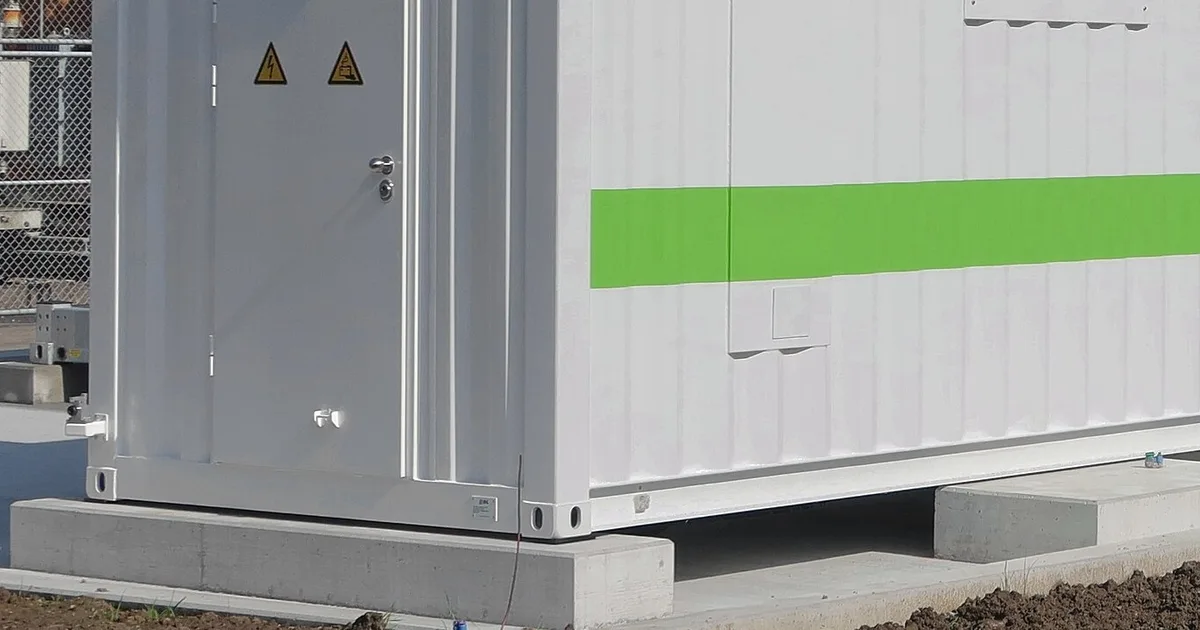
A battery energy storage system looks simple from the road: a row of white containers on a concrete pad. Underneath each one is a steel frame that carries tens of tonnes of batteries, takes the crane lift at the port and the site, keeps the enclosure level and gives the electrical system a reliable earth. Integrators and project developers in the US, Europe and Australia buy these frames and skids in volume, often hundreds at a time, and the order stands or falls on repeatability.
This article covers what a BESS base frame or skid has to do, which checks matter in fabrication and what to write on a purchase order for overseas production.
What a BESS frame carries
A containerised battery system includes battery racks, a battery management system, thermal management units, fire protection equipment and often the power conversion equipment. A 20-foot unit holding several megawatt-hours can weigh about 30 to 40 tonnes in total, depending on cell chemistry and design, and 40-foot units weigh more. The frame must carry that weight with no permanent deflection through the life of the project.
It also has to cope with:
- Concentrated loads where battery racks sit on the floor, often a tonne or more per rack in a small footprint.
- Lifting and transport loads, including crane lifts and lashing during sea freight.
- Wind and seismic loads at the site, which reach the foundation through the frame.
- Thermal and vibration effects from cooling equipment.
The design is the system integrator’s responsibility. The fabricator builds to the drawing, but should understand why each requirement exists.
Common frame and skid types
| Type | Description | Typical fabrication focus |
|---|---|---|
| Container base frame | Steel frame under a standard ISO-style enclosure, with corner fittings | Flatness, corner fitting position, lifting |
| Skid for outdoor cabinet | Beam frame carrying a cabinet or power conversion unit | Leveling feet, cable entry, lifting lugs |
| Transformer and inverter skid | Heavier frame for pad-mounted electrical equipment | Plate thickness, point loads, oil containment |
| Rack support frame | Internal frame or sub-base for battery racks inside an enclosure | Anchor plate positions, tolerances, grounding |
The shared principles of skid design are described in the article on equipment skid design: beam sizing and lifting lugs, and the logic of building complete packages off site in the article on modular skid packages and offsite fabrication.
Flatness and dimensional tolerance
Battery racks are tall and must stand plumb. The floor of the enclosure must be flat, and the enclosure must sit level on its foundation. Tight geometry is a repeat requirement across the whole fleet of units on a site.
Typical control points include:
- Flatness of the frame top within a few millimetres over the whole footprint, with the exact figure taken from the integrator’s drawing.
- Position of corner fittings and fork pockets within tight limits so that units stack, lift and align with others.
- Hole patterns for anchor bolts or foundation fixings.
- Rack anchor plates positioned within a millimetre or two of the drawing, since racks are pre-drilled.
- Overall length, width and height within container limits, with clearance for lashing.
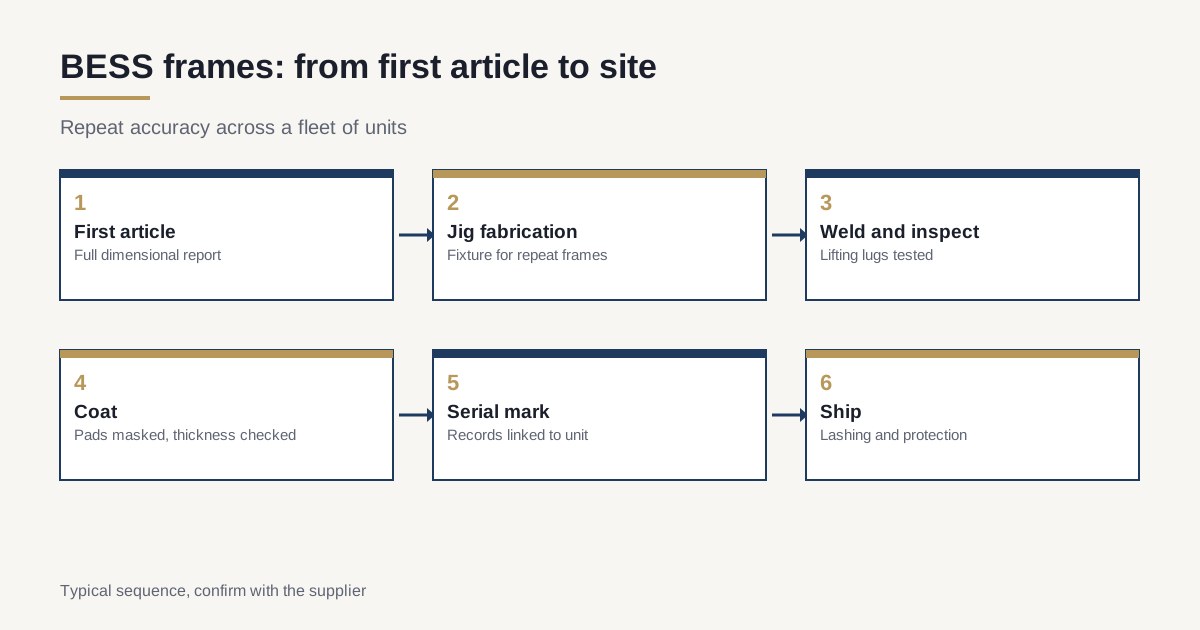
Welded frames distort. The shop should use a fixture or jig for the repeated frames and check the first article before the series starts. The article on welding distortion control for heavy plate explains the sequencing and clamping that keep a frame flat. For large orders, a first-article inspection with a full dimensional report is standard practice, and later units are spot checked. Measuring methods are covered in the article on dimensional inspection of large frames.
Lifting, tie-down and fork access
Units are lifted by crane at least twice and often more. Lifting points must be rated for the full loaded weight with a safety factor. Typical provisions are:
- ISO corner fittings for container-type frames, used with spreader beams or lifting slings.
- Lifting lugs or eyes for skids that are not container based, sized and tested to the project specification.
- Fork pockets for unloaded transport or yard movement, where specified.
- Tie-down points for lashing on a ship, truck or rail wagon.
Lifting lugs and their welds are safety parts. Their material, weld size and inspection should be stated on the drawing. If a proof load test is required, state the test load and who witnesses it.
Grounding, cable entries and drainage
Electrical systems need earth. Frames normally carry at least two grounding pads in diagonal corners, with a flat, clean, unpainted contact surface and a threaded or drilled hole for the earth lug. The pads must be masked during coating and cleaned afterwards.
Cable entries are another repeated detail. Floor openings, cable glands and conduit plates must be positioned to the drawing, with sealing arrangements so that water, dust and rodents cannot enter. Drain holes in the frame prevent water collecting in hollow members and corners.
Corrosion protection
BESS projects often sit in coastal sites, deserts and industrial zones for 20 years or more. Steel frames need a coating system matched to the site’s corrosivity category, usually C4 or C5 under ISO 12944 for harsh sites. The main choices are:
- Hot-dip galvanising, common for skids, with ISO 1461 or ASTM A123 coating thickness. The kettle size limits the frame size, and the frame needs vent and drain holes so that zinc flows in and out. Distortion during galvanising must be controlled.
- Blast and paint, with zinc-rich primer, intermediate coat and topcoat.
- Duplex systems, galvanising plus paint, for the harshest sites.
Hollow sections must be sealed or vented according to the coating method. Details of finish choices and their inspection are covered in the article on surface finish systems for structural steel.
Welding and quality level
BESS frames are usually built under a structural welding code such as AWS D1.1 or EN 1090 with an execution class set by the project, commonly EXC2 for this kind of structure. Lifting lugs and primary load paths often get higher weld quality and inspection. For a large series, ask for:
- Welding procedures and welder qualifications for the joints used.
- Visual inspection of 100 percent of welds and magnetic particle testing of lifting lugs and other critical welds.
- Material certificates for the main steel, as explained in the article on EN 10204 3.1 and 3.2 certificates.
- Traceability from certificate to part for lifting components.
Fire safety and system certification
Battery systems are subject to strict fire and electrical safety rules, such as UL 9540 and the UL 9540A test method in North America, NFPA 855 for installation and IEC 62933 standards internationally. These apply to the system, not to the steel frame. The frame must however allow the system to meet them: fire barrier mounting points, vent and exhaust paths, gaps required by the layout and non-combustible materials where the design requires it. The fabricator should not alter these without written approval from the integrator.
Shipping and handling
A fleet of frames can ship efficiently if they are designed for it. Skids may be nested or stacked, and containers can be shipped as complete units or as frames with equipment installed on site. Key points:
- Container fit. Check that stacked frames or complete units fit the container, flat rack or ship deck chosen. The planning for oversize units is described in the article on out-of-gauge breakbulk shipping.
- Protection of grounding pads and threaded holes with caps and tape.
- Marking of each frame with a unique serial number that links to the quality records.
- Incoterms that define where responsibility passes, as explained in the article on Incoterms for heavy fabrication.
For US projects, tariffs on imported steel products can change the landed cost. See the article on Section 232 tariffs on imported steel frames.
What to write on the order
- Frame drawing, with flatness, hole pattern and lifting point tolerances.
- Material grades and certificates, including lifting lug material.
- Welding code and execution class, with inspection scope.
- Coating system and thickness, with grounding pad masking.
- First article inspection with a dimensional report and release before series production.
- Marking and serial numbers for each unit.
- Packing and shipping method with lashing and protection details.
Checklist before series production
- First article inspected and signed off by the integrator.
- Jigs and fixtures built for repeat accuracy.
- Lifting points checked, with weld inspection recorded.
- Grounding pads, cable entries and drains verified.
- Coating system tested and approved.
- Serial numbers and records linked.
- Shipping loads planned and lashing tested.
The rest of the skid order, from scope to acceptance, is covered in the steel skid fabrication guide.
If you integrate BESS and need frames or skids built to a repeat drawing, send the drawing with the quantity and delivery plan. We reply within 24 business hours.