Plate Rolling and Press Brake Forming for Heavy Steel Structures
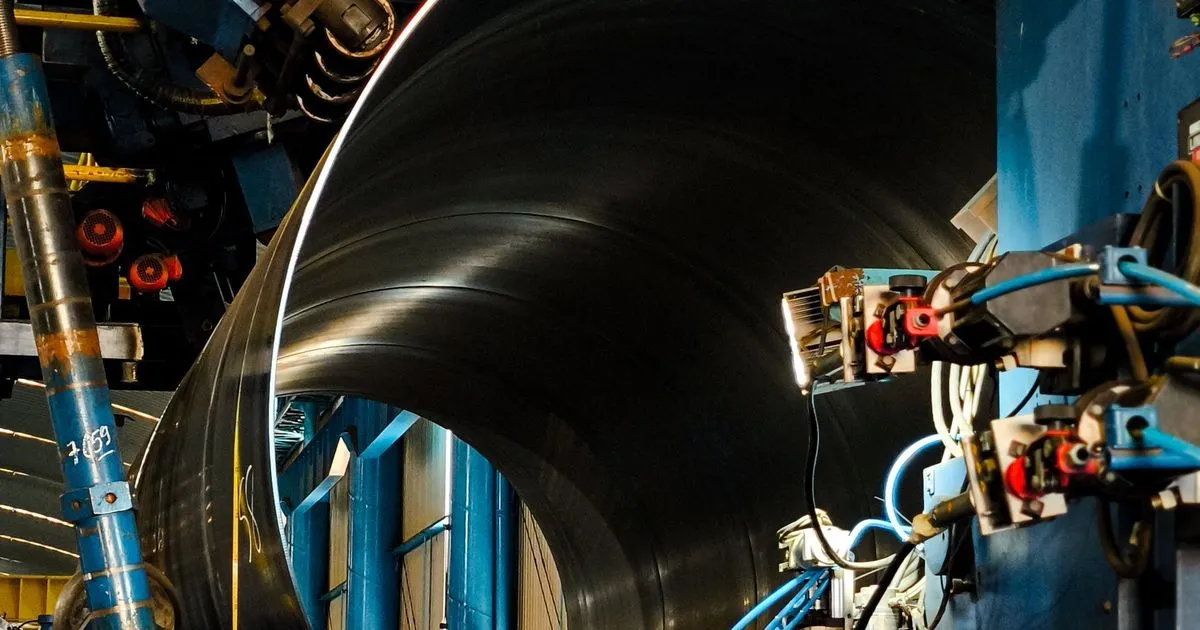
Not every part of a heavy frame is built from flat plates welded at right angles. Cylindrical shells, curved guards, box channels, hopper sides and rolled flanges all start as flat plate and are formed cold or hot into shape. Forming reduces weld length and often gives a stronger part than a weldment made from several pieces. It also brings its own limits: bend radius, springback, residual strain and machine capacity.
This guide covers plate rolling and press brake forming on thick structural plate, roughly 10 mm to 80 mm, and what a buyer should check before a forming job is awarded.
The two main forming routes
Plate rolling passes plate between rolls that bend it progressively into a curve. A three-roll machine has two bottom rolls and a top roll. A four-roll machine adds a side roll that holds the plate and allows it to be pre-bent and rolled in one pass. Rolling produces cylinders, cones and large-radius curves.
Press brake forming pushes a punch into a V-shaped die, bending plate along a straight line. It produces angles, channels, boxes, flanges and hat sections. A heavy press brake is rated in tonnes of force and bed length.
Hot forming and forging sit alongside these for very thick or very tight shapes. They need a furnace, are slower and add a heat-treatment history that the order must account for.
| Method | Best for | Typical limit to check |
|---|---|---|
| Three-roll plate roll | Cylinders, large-radius curves | Flat ends left at each edge unless pre-bent |
| Four-roll plate roll | Cylinders with tight ends, cones | Machine capacity for plate thickness and width |
| Press brake | Straight-line bends, channels, boxes | Bed length, tonnes per metre, minimum radius |
| Hot forming | Thick plate, tight radii | Heat-treatment history, scale, distortion |
Bend radius: the first limit
Steel cannot be bent to any radius. Tighter bends stretch the outer fibres and compress the inner fibres, and if the strain is too high the outside cracks. The minimum inside radius depends on plate thickness, yield strength, direction of rolling and edge condition.
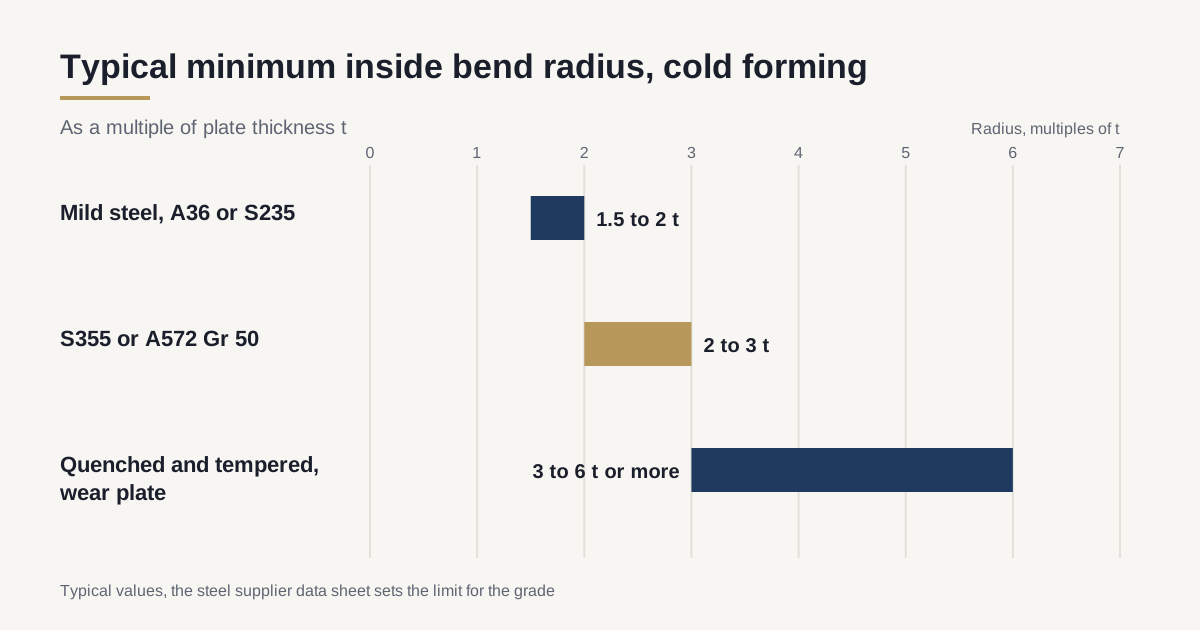
A rule of thumb for cold bending carbon structural steel is a minimum inside radius of about 1.5 to 2 times the plate thickness for lower-strength grades. Higher-strength grades need a larger radius, often 2 to 3 times the thickness or more. Quenched and tempered and abrasion-resistant plates may need several times the thickness and sometimes preheating. These are typical figures, and the steel supplier’s data sheet should be the final reference for the grade in use.
| Steel type | Typical minimum inside radius, cold bend | Comment |
|---|---|---|
| Mild structural, A36 or S235 | 1.5 to 2 t | Most forgiving |
| Higher-strength structural, S355 or A572 Gr 50 | 2 to 3 t | Springback increases |
| Quenched and tempered or wear plate | 3 to 6 t or more | Supplier limits apply, cracking risk |
Bend direction matters. Plate has a rolling direction from the mill, and tight bends are safer when the bend line runs across it rather than along it. Drawings for formed parts should show the preferred direction when a tight radius is needed.
Edges matter too. Rough thermally cut edges and notches act as crack starters at the outside of a bend. Grinding the edge and the corners before bending is cheap protection.
Springback and tolerance
When the bending force is released, the plate springs back slightly. The amount grows with yield strength and with the ratio of radius to thickness. A plate bent to 90 degrees may rest at 92 or 93 degrees. Operators compensate by over-bending, then measure and correct.
On thick plate this is trial and adjustment. The first part is often a test piece. Ask whether the quote includes setup plates, because a frame with one critical formed section is worth testing on offcuts first.
For rolled shells, the usual quality measure is roundness. Pressure-vessel codes commonly limit the difference between maximum and minimum diameter to about 1 percent of nominal. Structural frames are less strict, but a rolled shell that must fit a bearing housing or flange needs a stated tolerance and a check with a template or tape.
Flat ends on rolled plate
A three-roll machine cannot bend the last stretch of plate at each end, because there is no roll beyond the plate edge to push it. This leaves a flat strip, roughly half the distance between the bottom rolls. If the part is a cylinder, the flats show up as an out-of-round zone near the seam.
There are three remedies. The plate can be pre-bent at the ends on a press brake. The plate can be rolled longer and trimmed. Or a four-roll machine can be used, which pre-bends ends in the same setup. Ask which route the shop uses, and check that the quote includes it.
Cold work and when heat treatment is needed
Bending work-hardens the steel and uses up some of its ductility. Codes watch the amount of strain. The extreme fibre strain in a bend is roughly proportional to thickness divided by radius: a tight bend means high strain.
Pressure-vessel and offshore specifications often require stress relief or impact re-testing when cold forming strain exceeds a threshold, commonly around 5 percent. Structural work for static loads is usually less strict. If a formed part sees cold service or fatigue, tell the shop, and ask which standard sets the forming limit. The same concern shows up in the article on Charpy impact requirements for cold-climate steel frames.
Heat is a separate issue. Hot forming carbon steel near 900 to 950 degrees Celsius is normal for plain grades. Thermo-mechanically controlled rolled plates, often marked with an M in the grade, can lose strength if heated above their stated limit. Never assume a hot-formed plate has the same properties as the delivery condition. Check the plate supplier’s recommended temperature limits.
Welding rolled and formed parts
Rolled cylinders need longitudinal seam welds, usually made on the flat plate before rolling or on the formed shell, depending on thickness and tolerance. Check the sequence: if the seam is welded after rolling, weld shrinkage pulls the shell out of round, and a final light roll corrects it. If the seam is welded before rolling, the weld must be ground flush so it passes through the rolls without damage.
On formed channels and box sections, the usual concern is distortion from welding the cut edges and stiffeners. The principles in the article on welding distortion control for heavy plate apply directly.
Machine capacity: what to ask
A shop’s forming capacity is set by its machines. Ask for these numbers:
- Plate roll: maximum plate thickness and width at the minimum shell diameter, and whether the machine is three-roll or four-roll.
- Press brake: tonnes of force, bed length and maximum throat depth.
- Overhead crane capacity: a 40 mm by 3 m by 10 m plate weighs about 9.4 tonnes, and the crane must lift it and hold it during forming.
- Tooling: the available V-die opening and punch radius, because these set the achievable inside radius.
A plate that is too thick for the roll’s rated capacity can be formed in passes but may leave marks or a flat spot. A part longer than the press brake bed must be bent in sections, and the joins can show. If the capacity is borderline, the safer routes are either to split the part or to move the job to a shop with larger machines. This is also a reason to assess the shop’s capacity before you commit.
Cost drivers
Forming is billed by machine hours and setup. The main drivers are plate thickness, radius, part length, number of identical parts and handling. A 30 mm cylinder with 3 m diameter is quick on a big roll and slow on a machine near its limit. The same logic as in what drives cost in heavy frames and skids holds here: heavy plate, handling and machine time are most of the price.
What to put on the drawing
- Inside or outside radius of each bend, with tolerance.
- Bend direction relative to rolling direction, when it matters.
- Material grade and condition, such as “S355J2+N” or “A572 Gr 50”.
- Forming method restrictions, for example “cold forming only” or “no hot forming”.
- Roundness tolerance for rolled shells.
- Whether stress relief or impact retest is required after forming.
Checklist before a forming job
- Minimum radius checked against the steel supplier’s guidance.
- Rolling direction versus bend line confirmed.
- Edges ground before bending, where tight radii are used.
- Pre-bending method for rolled ends agreed.
- Machine capacity and crane limits stated by the shop.
- Cold work limits and heat-treatment needs agreed for cold or fatigue service.
If your frame has rolled or bent plate and you want to know which shops can handle the thickness, send the drawing. We reply within 24 business hours with shop options and the questions we would ask each of them.