Charpy Impact Requirements for Cold-Climate Steel Frames
Steel does not fail the same way at every temperature. At room temperature, a structural plate bends and stretches before it breaks. Cool the same plate far enough and it can crack suddenly with little warning, at a stress well below its yield strength. This is brittle fracture, and it is the reason frames for cold regions carry impact test requirements that frames for warm climates often do not.
The Charpy test is the standard measure. This article explains what it tells a buyer, how common steel grades relate to test temperature and how to write a requirement that a shop and its mill can meet.
What the Charpy V-notch test measures
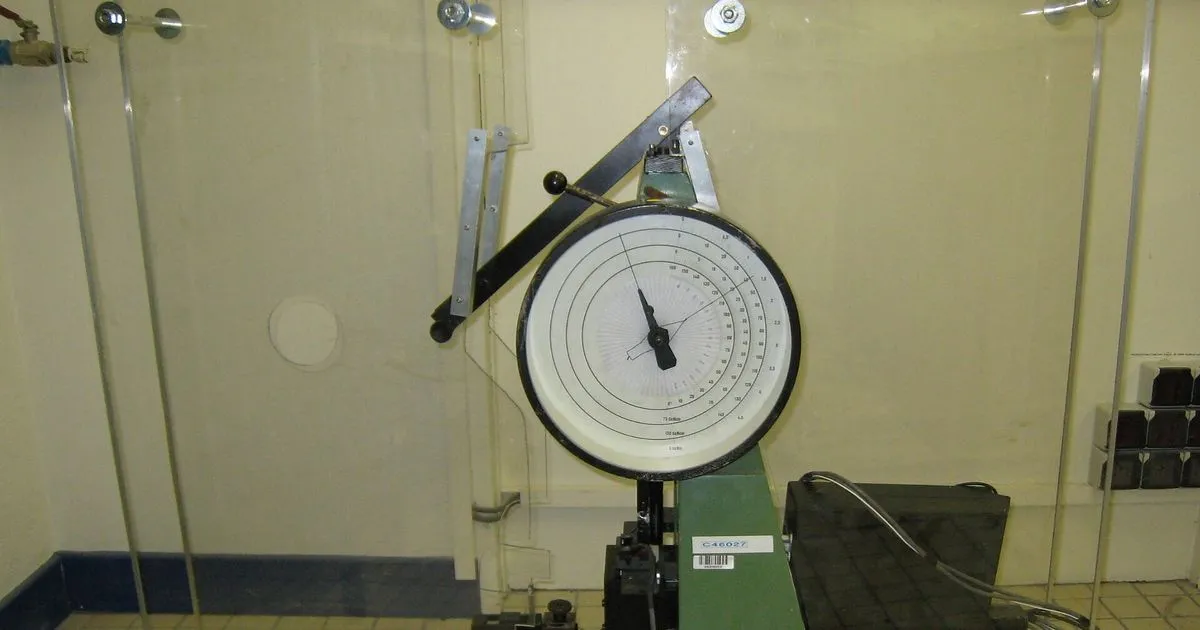
A Charpy test swings a heavy pendulum into a small notched bar of steel and measures how much energy the bar absorbs while breaking. The standard bar is 10 mm by 10 mm by 55 mm with a V-shaped notch in the middle, tested to ISO 148-1 or ASTM A370. The result is the absorbed energy in joules, or foot-pounds in US practice.
A tough steel absorbs a lot of energy because it deforms before it breaks. A brittle steel absorbs little. Steel moves from tough to brittle over a temperature range, called the ductile-to-brittle transition. Charpy tests at several temperatures draw this curve. For ordering, the buyer usually names one test temperature and a minimum energy, and the plate must pass at that temperature.
The test does not give a design strength. It is a screening measure that shows whether the steel has enough toughness at the temperature it will see.
How common grades map to test temperature
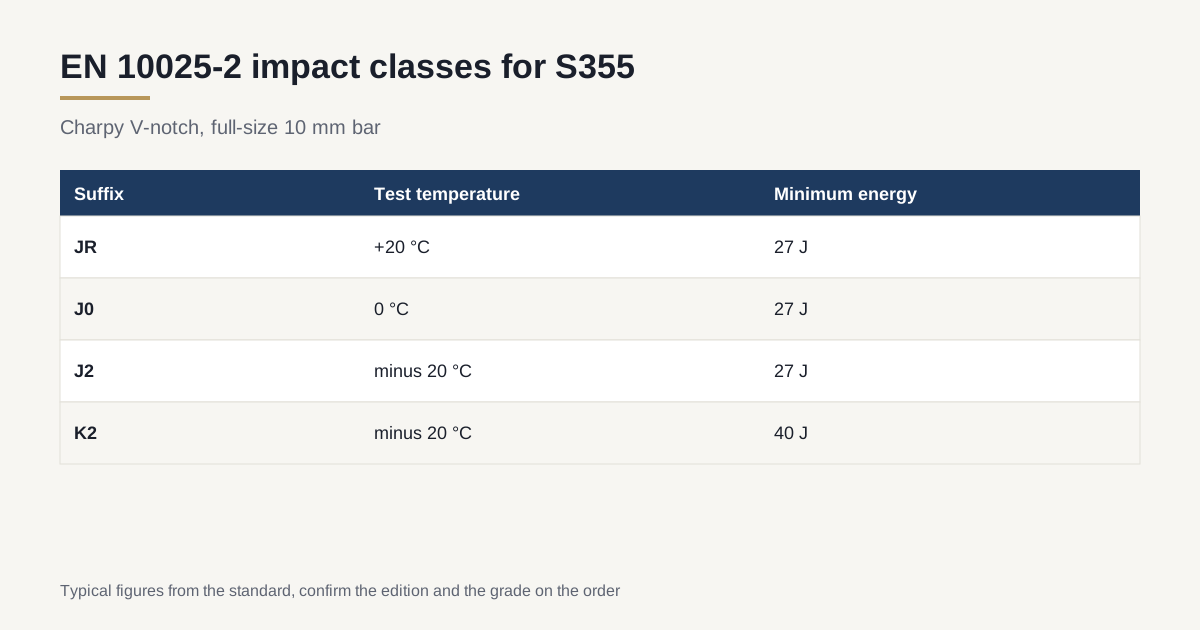
Steel grade names often encode the impact requirement. Under the European structural standard EN 10025-2, the suffix after the yield strength shows the test:
| Grade suffix | Test temperature | Minimum energy (full-size bar) |
|---|---|---|
| JR | +20 degrees Celsius | 27 J |
| J0 | 0 degrees Celsius | 27 J |
| J2 | minus 20 degrees Celsius | 27 J |
| K2 | minus 20 degrees Celsius | 40 J |
So S355J2 is a 355 MPa steel that must absorb at least 27 J at minus 20 degrees Celsius, and S355K2 must absorb 40 J at the same temperature. For colder service, EN 10025-3 and 10025-4 cover normalised and thermomechanical grades with an L suffix, such as S355NL, which carry requirements down to minus 50 degrees Celsius.
US practice differs. ASTM A36 carries no mandatory Charpy requirement. ASTM A572 Gr 50 can be ordered with a supplementary requirement for impact testing at a stated temperature. Bridge grades under ASTM A709 have impact requirements tied to a temperature zone. If the order says only “A36” or “A572 Gr 50”, the plate may arrive with no impact data at all. A comparison of the common structural grades is in the article on steel grades for heavy weldments.
Choose the test temperature from the service temperature
Start from the lowest temperature the frame will realistically see, sometimes called the lowest anticipated service temperature. For a frame in a mine in northern Canada or Scandinavia that might be minus 40 degrees Celsius. For equipment in a northern US state it may be minus 20 to minus 30.
Then set the test temperature at or below that service temperature, adjusted for factors that raise the risk:
- Thickness. Thick plate is more likely to be brittle than thin plate at the same temperature. Many design codes limit the thickness allowed for a given grade and temperature, or ask for a colder test temperature as thickness rises.
- Loading rate. Impact loads, such as crane drops or machine shock, are worse than slow static loads.
- Stress concentration. Notches, weld toes, thick welded joints and sharp changes of section raise the chance of crack initiation.
- Residual stress. Heavily welded and restrained joints carry locked-in tensile stress.
A European design to EN 1993-1-10 gives a table of maximum thickness by steel grade and reference temperature. Use that or the equivalent code that governs your structure.
Where the test sample comes from
Impact results depend on where the specimen was cut. Three things matter:
- Orientation. Specimens cut across the rolling direction, called transverse, usually give lower values than those cut along it, called longitudinal. Specify which direction applies, as many specifications call for transverse tests on plate.
- Position in thickness. Samples are usually taken at a quarter of the thickness, or at mid-thickness on very thick plate.
- One test per lot. A standard test covers one heat or one plate lot. Individual plates may differ. For critical frames, the order can require testing per plate rather than per heat.
A Charpy result on a 20 mm plate does not say anything about a 70 mm plate from the same heat. State the thickness range that each certificate must cover.
Acceptance values
The usual acceptance rule for a set of three specimens is that the average meets the minimum, and no single result falls below about 70 percent of that minimum. For a 27 J requirement, that means an average of 27 J or more with no single value below 19 J. The exact criteria are set by the standard, and some codes use stricter rules.
Smaller bars are used on thin plate. A 5 mm wide sub-size specimen carries a reduced minimum, usually in proportion to its width. If your frame uses thin plate in a cold environment, check how the standard adjusts the requirement.
Welds and heat-affected zones count too
Base plate impact data is only part of the story. Welding changes the steel next to the weld, and the weld metal has its own toughness. For cold service, the welding procedure qualification should include Charpy tests of the weld metal and the heat-affected zone at the same temperature as the plate, with notches placed in each region.
This is why consumables matter. Filler metals carry their own impact classification. For example, E7018-1 electrodes are rated for impact at a lower temperature than standard E7018. A shop that welds a K2 plate with an untested consumable gains nothing from the plate’s toughness. Check the procedure record for the impact results, as described in the article on reading a WPS and PQR before ordering.
Heat input and preheat also affect weld toughness. Too much heat coarsens the grain and lowers impact values. Controls on interpass temperature are covered in the article on preheat and interpass temperature.
Other parts of the frame
A frame has more than plate and welds.
- Bolts. High-strength bolts in cold service may need impact-rated grades. Ordinary fasteners can be brittle at low temperatures.
- Castings and forgings in the assembly need their own impact requirements.
- Coatings and galvanising. Hot-dip galvanising can reduce toughness slightly in some steels, so check combinations for critical parts.
- Cold forming. Heavy bending uses up ductility and can raise the transition temperature in the bent area. See the article on plate rolling and press brake forming.
Cost and lead time
Impact-tested plate costs more than untested plate, and low-temperature grades cost more again. A step from J0 to J2 is a modest increase. A step to normalised L grades is larger, and mill lead times can be longer because those plates are rolled in smaller batches. Ask for plate availability before committing to a delivery date. The cost effect of material choice is part of the picture in the article on what drives cost in heavy frames and skids.
Over-specifying is also a cost. A frame in a mild climate does not need minus 40 degrees Celsius plate. Match the requirement to the real service temperature and keep the tests that matter.
What to write on the order
- Grade and standard with impact class, such as EN 10025-2 S355J2 or S355K2, or ASTM A572 Gr 50 with a stated Charpy requirement.
- Test temperature and minimum energy in the units the standard uses.
- Specimen orientation and position, typically transverse at a quarter thickness.
- Certificate type, showing the real test results for the plates supplied. See the explanation of EN 10204 3.1 and 3.2 certificates.
- Welding procedure impact tests in weld metal and heat-affected zone at the same temperature.
- Consumable classification with an impact rating that matches.
- Thickness range each certificate must cover.
Checklist before release
- Lowest service temperature written down and agreed.
- Test temperature set at or below it, adjusted for thickness.
- Plate certificates reviewed for the right grade, temperature and energy.
- Welding procedure includes impact tests that match.
- Filler metals and bolts carry suitable impact ratings.
- Shop told whether the frame sees impact loading.
If your frame is going to a cold site and you are unsure which grade is enough, send the drawing with the site temperature. We reply within 24 business hours and can check the plate and procedure paperwork before you place the order.
See also: the structural steel grades hub, which places every common frame grade by yield and impact test temperature.