Reading a WPS and PQR Before Placing a Heavy Fabrication Order
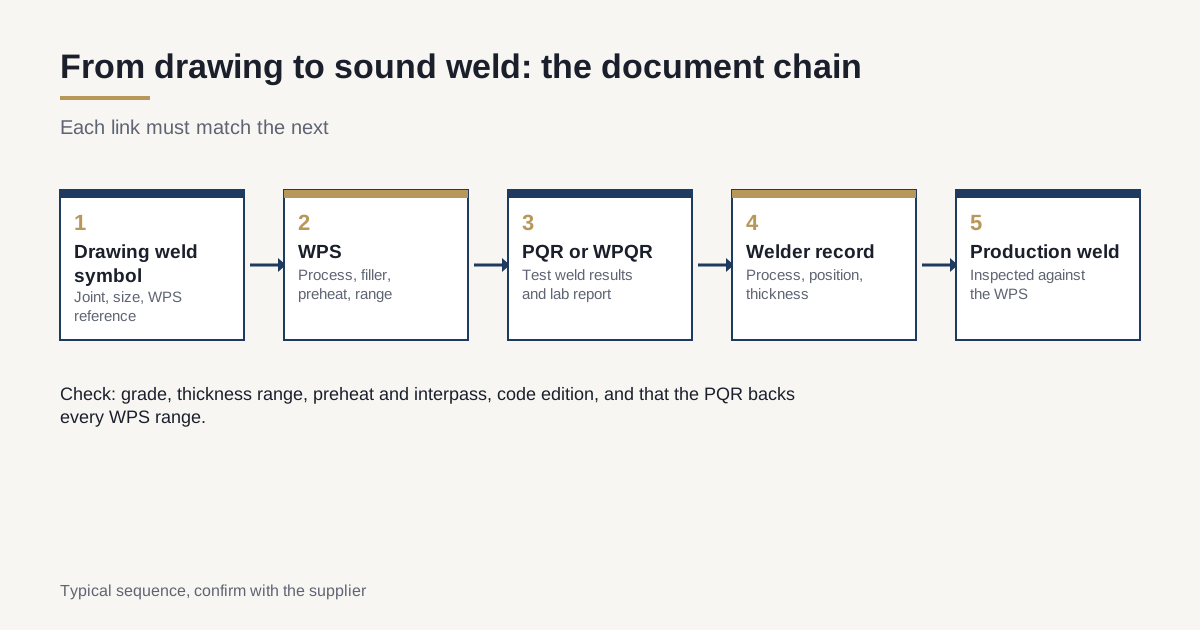
A fabricator that says “our welders are certified” has told you almost nothing about the weld in your frame. Welder qualification shows that a person can make a sound weld under test conditions. The welding procedure shows how that weld must be made on your joint, in your steel, at your thickness. Two documents carry that information: the welding procedure specification (WPS) and the procedure qualification record (PQR).
Reading them takes about twenty minutes and is one of the cheapest checks a buyer can make. This article explains what each document is, which fields matter on heavy plate and what a mismatch looks like.
WPS and PQR: two different documents
The WPS is the instruction. It tells the welder and the inspector how to weld a defined joint: the process, the filler metal, the preheat, the current range, the travel speed, the shielding gas and the position. A welder follows it on the floor. An inspector checks the production weld against it.
The PQR is the proof. It records what actually happened when a test weld was made and tested to confirm the procedure works. It lists the actual parameters used, then the results of the tests: tensile strength, bend tests, sometimes impact tests and hardness. A WPS without a PQR behind it is an untested recipe, unless the code allows it to be prequalified.
In EN and ISO systems the same ideas appear under different names. The record is called a welding procedure qualification record (WPQR) and the tests follow ISO 15614-1 for arc welding of steel. The WPS format follows ISO 15609-1. The principle is identical: a written procedure backed by a test.
Welder qualification is a third document. A welder qualification record under AWS D1.1 or ISO 9606-1 shows that a named person passed a test for a given process, position and thickness range. You need all three to connect the person, the procedure and the proof.
What the fields mean on thick plate
A WPS has many fields. On heavy frames, these decide whether the weld is sound:
| Field | What it controls | What to check against the order |
|---|---|---|
| Welding process | Arc process such as SMAW, GMAW, FCAW or SAW | Matches the process the shop will really use |
| Base metal group and grade | Which steels the procedure covers | Includes your grade, for example A572 Gr 50 or S355J2 |
| Thickness range | Plate thickness the procedure qualifies | Covers every thickness on the drawing |
| Joint design | Groove angle, root gap, backing | Matches the joint detail on your drawing |
| Filler metal classification | Wire or electrode type and strength | Strength matches or exceeds the base metal requirement |
| Preheat minimum | Lowest plate temperature before welding | Reasonable for the grade and thickness |
| Interpass maximum | Highest temperature between passes | Stated, and not blank |
| Heat input range | Energy per length of weld | Within the range tested in the PQR |
| Position | Flat, horizontal, vertical, overhead | Covers the positions the frame needs |
| Post-weld heat treatment | Whether PWHT is part of the procedure | Consistent with the drawing note |
Preheat and interpass limits are especially important on plate above about 25 mm. Without them, the heat-affected zone can crack as hydrogen collects in a fast-cooling joint. The article on preheat and interpass temperature on thick steel covers how to specify them.
What the PQR proves and what it does not
A PQR is a snapshot of one test weld. The tests commonly include:
- Tensile tests across the weld. They confirm the joint is at least as strong as the base metal. The break should occur outside the weld or above the required strength.
- Guided bend tests. Face and root bends reveal lack of fusion and cracks that a tensile test can miss.
- Macro examination. A polished and etched cross-section shows fusion, penetration and the heat-affected zone.
- Impact tests. Charpy tests at a stated temperature are included only if the code or the order requires them. They matter for cold service. See the article on Charpy impact requirements for cold-climate steel frames.
- Hardness survey. Common under ISO and offshore specifications, less common under basic AWS D1.1 work.
A PQR only proves the welding variables inside its tested range. It does not prove the weld will be good if production moves outside that range. That is why the range of qualification matters more than the test itself.
The thickness trap
Thickness is the most common place where a procedure and a job disagree. A PQR made on 12 mm plate does not automatically cover 60 mm plate.
Under AWS D1.1, a groove weld test on plate of about 25 mm or more typically qualifies unlimited thickness, while a thinner test plate qualifies only up to twice its thickness. Under ISO 15614-1 the qualified range is generally narrower, often from half the test thickness to twice the test thickness for tests above 12 mm. These are typical rules, and the exact limits depend on the code edition and the test details, so confirm them in the standard that applies to your order.
The practical check is simple. Take the thickest plate in your frame and the thinnest. Then confirm that each falls inside the range written on the WPS and supported by the PQR thickness.
Prequalified procedures under AWS D1.1
AWS D1.1 allows some procedures to be used without a PQR test, called prequalified WPS, if they follow the code’s prescribed limits for process, joint, filler metal and parameters. This is legitimate and common for ordinary structural welding. It does not mean no paperwork. The shop still needs a written WPS that shows it stays inside the prequalified limits. It also does not extend to every process, and some conditions, such as short-circuit transfer in gas metal arc welding, are outside it.
If a shop says its procedures are prequalified, ask for the WPS and check that the stated parameters fit the code limits for the process in use. For more on how this code treats structural frames, see the guide to AWS D1.1 weld standards for structural frames.
Red flags in a document pack
- One WPS for all joints. Different thicknesses, positions and joint types normally need different procedures or a procedure with clearly defined ranges.
- A PQR with no test report. A summary page without laboratory results proves nothing. Ask for the lab report and the testing date.
- Preheat or interpass left blank. On thick plate this is a sign that temperature control is not part of the shop’s practice.
- PQR parameters outside the WPS range. If the PQR was welded at 180 amps and the WPS allows 300, the high end is untested.
- Wrong process on the shop floor. A WPS written for stick welding while the shop uses flux-cored wire means the work is not following a qualified procedure.
- Outdated or unspecified code edition. The WPS should name the code and edition used.
- Signatures missing or dates inconsistent. A qualification record should be signed and dated by the person who witnessed the test.
- Welder qualification that does not match. A welder qualified in flat position on 10 mm plate has not qualified for vertical welds on 50 mm.
A single red flag may be a paperwork error. Several together suggest the documents were assembled for the audit and are not used in production.
How to request the documents
Ask for three things before you award the order:
- The WPS list for the joints on your drawing, with identification numbers.
- The supporting PQR or WPQR for each, including the laboratory test report.
- Current welder qualification records for the welders assigned to the job, with the process and range shown.
Match the WPS numbers to the weld symbols on the drawing. Many drawings carry a WPS reference in the tail of each weld symbol, which makes the check mechanical. If your drawing does not show them, add a general note requiring welds to follow qualified procedures to the stated code. The weld inspection steps that follow are described in the article on non-destructive testing for heavy weldments.
When a buyer cannot read the documents
Not every buyer has a welding engineer. Many procurement and design teams have no one who reads a WPS daily. This is where a sourcing partner earns its place: we ask for the pack, check the fields in the table above and report mismatches in plain language before you commit to a shop. Our own selection steps are described on the how we vet page.
Checklist before the order
- WPS covers your steel grade, thickness range and joint types.
- PQR or WPQR is attached, with the laboratory report.
- Preheat, interpass and heat input are stated and consistent with the PQR.
- Impact test results are present if the order requires them.
- Welders are qualified for the process, position and thickness in use.
- Code and edition are named on every document.
If you have a drawing and want the document pack checked against it, send the drawing. We reply within 24 business hours and will tell you which shops hold procedures that fit your frame.