Preheat and Interpass Temperature on Thick Steel: What to Specify
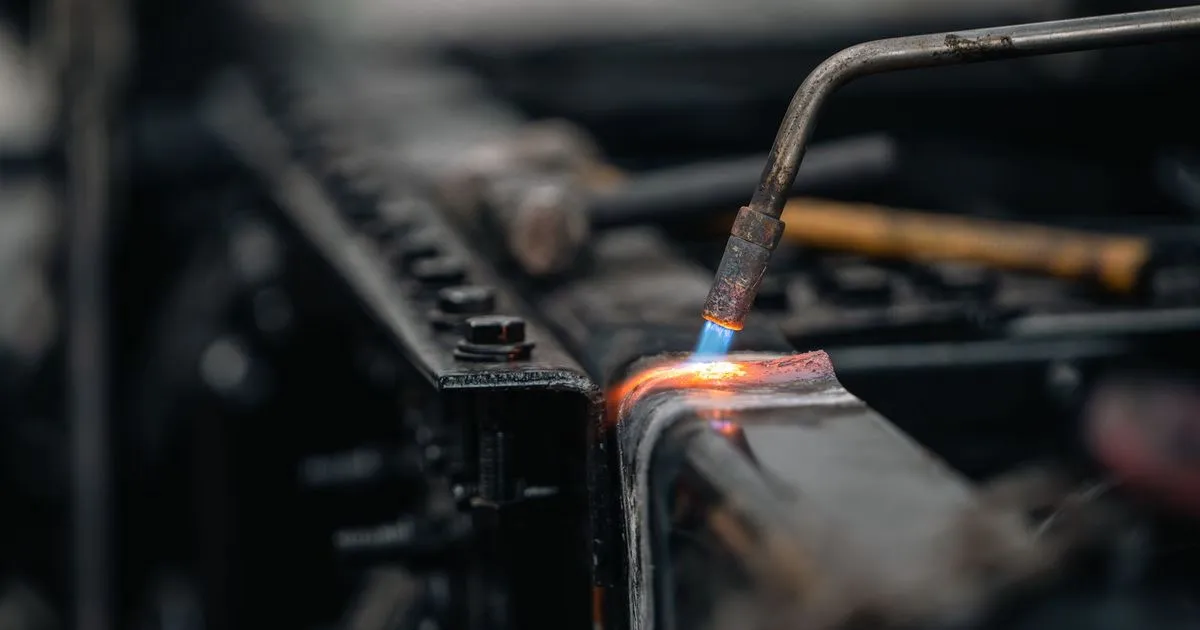
Cold cracking is the weld defect that appears hours or days after the shop has gone home. The weld looks sound, passes visual inspection and then shows a crack along the heat-affected zone the next morning. On thick structural steel, the usual cause is not a bad welder. It is a plate that cooled too fast, with hydrogen trapped in the joint.
Preheat and interpass temperature are the controls against it. They cost little compared with a cracked frame, yet they are often missing from the drawing and vague in the quote. This article explains what they do, what sets the numbers and how to specify them so a sourcing desk or a buyer can verify them.
What preheat does
Preheat raises the plate temperature before the arc starts. It does three useful things.
First, it slows cooling. A cold, thick plate pulls heat out of the weld very fast, and the steel next to the weld cools into a hard, brittle structure. A warm plate cools more slowly and forms a softer, tougher structure.
Second, it gives hydrogen time to leave. Hydrogen enters the weld from moisture in electrodes, flux, gas or on the plate. At high cooling rates it stays trapped and builds pressure at the hardened zone. At a higher temperature it diffuses out before the joint cools.
Third, it reduces shrinkage stress by lowering the temperature difference between the weld and the surrounding plate.
Cold cracking needs three conditions at once: hardened microstructure, hydrogen and tensile stress. Preheat works on the first two, and low-hydrogen consumables cut the second further. Restraint, which is high on thick plate and stiff frames, is the one that cannot easily be removed.
What sets the minimum preheat
No single number fits all steel. The minimum depends on four things.
- Thickness. Thicker plate removes heat faster. Codes usually work from the thickest part in the joint, or from a combined thickness at a T-joint.
- Carbon equivalent. Higher carbon and alloy content makes the steel harder after fast cooling. Structural grades such as A36 and S235 need little. Higher-strength grades such as A572 Gr 50 and S355 need more, and quenched and tempered grades need controlled limits on both ends.
- Hydrogen level of the process. Low-hydrogen electrodes, solid wire and properly stored flux-cored wire allow lower preheat than cellulosic or damp consumables.
- Restraint. A joint that cannot shrink freely, such as a stiffener welded into a thick box section, needs more preheat than a free edge.
Typical minimum preheat by thickness
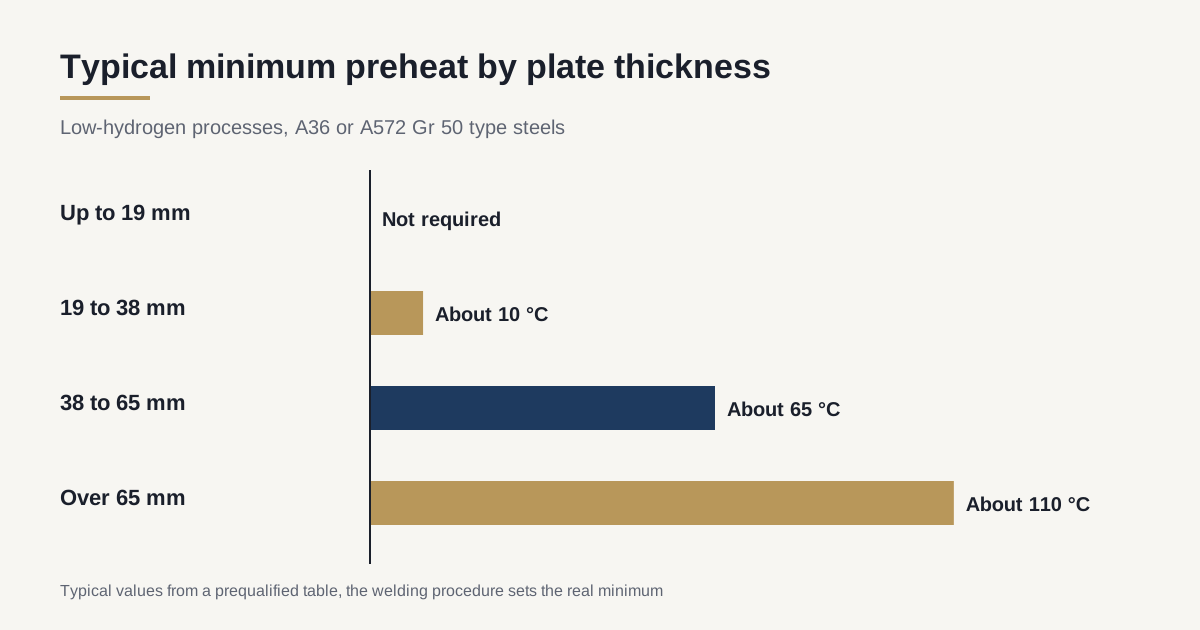
Codes give tables. As an example, the AWS D1.1 prequalified tables for common structural steels such as A36 and A572 Gr 50 with low-hydrogen processes follow this pattern:
| Thickness of thickest part | Typical minimum preheat |
|---|---|
| Up to 19 mm | Not required, except in cold conditions |
| Over 19 mm up to 38 mm | About 10 degrees Celsius |
| Over 38 mm up to 65 mm | About 65 degrees Celsius |
| Over 65 mm | About 110 degrees Celsius |
These are typical figures from a prequalified table. Real procedures often use higher values because of restraint, grade, ambient conditions or the shop’s own testing. Under EN 1011-2, the preheat is calculated from carbon equivalent, thickness and hydrogen class, and typical values for S355 plate above 40 mm are in the range of 100 to 150 degrees Celsius. Use the table as a sense check, and confirm the actual number in the welding procedure for your steel grade. The procedure and its test record are the subject of the article on reading a WPS and PQR before placing an order.
Interpass temperature: the upper limit
Interpass temperature is the plate temperature between weld passes. A procedure sets a minimum, which is usually the same as the preheat, and a maximum.
The maximum matters because too much heat is also harmful. On carbon steel, high interpass temperature coarsens the grain and lowers toughness in the weld and heat-affected zone. On quenched and tempered steel, it can soften the plate below its specified strength. Typical maximum interpass values for carbon and carbon-manganese structural steel fall around 230 to 260 degrees Celsius. Quenched and tempered grades often have a lower cap set by the steel producer. If a procedure gives a minimum and no maximum, ask why.
On a large frame, the thick sections hold heat and the thin sections do not. A frame that is welded fast and continuously can overheat between passes. A frame that is welded one pass a day cools below the minimum and needs reheating.
How preheat is applied
| Method | How it works | Typical use |
|---|---|---|
| Gas burners or ring torches | Flame heats the joint area | Common on thick plate and large frames |
| Electric resistance blankets | Heating elements wrap the joint | Controlled, repeatable, good for long soaks |
| Induction heating | Coil induces heat in the steel | Fast, even, used on heavy sections |
| Furnace | Whole part heated in an oven | Small to medium parts, high preheat |
The heated zone must be wide enough. AWS D1.1 requires the minimum preheat to be maintained at a distance equal to the thickness of the thickest part, but not less than 75 mm, in every direction from the joint. A torch that warms a narrow strip along the weld line and nothing else fails this requirement even if the surface reads correct.
How temperature is measured
Surface temperature is checked with one of three tools: temperature-indicating crayons or paints that melt at a fixed temperature, a contact pyrometer or a thermocouple attached to the plate. Infrared guns are common but read poorly on bare shiny steel unless calibrated against emissivity.
Measurement location matters. The reading should be taken on the plate at the specified distance from the joint, not on the torch flame or on a hot spot. On thick plate, the surface can reach the target before the core does, so a soak time is often added. A typical rule of thumb is to wait several minutes per 25 mm of thickness after the surface reaches temperature, but the welding procedure should state the actual requirement.
Post-heat and hydrogen bake
On thick, restrained joints a shop may apply post-heat, also called a hydrogen bake. The joint is held at 200 to 300 degrees Celsius for a few hours after welding so hydrogen can escape. A simpler alternative is slow cooling under insulation blankets. Both help on very thick or high-strength material.
Post-heat is not the same as post-weld heat treatment for stress relief. Stress relief runs much hotter and is controlled separately. See the article on stress relief for welded machine bases.
Cold weather and tack welds
Ambient temperature matters. Steel left outside in cold weather can be well below the minimum preheat before any heating starts, and steel stored in a damp yard may have condensation on the surface. A shop welding frames in an unheated area in winter needs a plan for bringing plate up to temperature and keeping it there.
Tack welds and fit-up welds count as welds. They are short and cool quickly, which is the worst case for cracking. They should be made with the same preheat as the final weld and with consumables that match the procedure.
What to write on the order
Keep the instruction short and verifiable:
- Welding to follow qualified procedures with preheat and interpass stated in each.
- Minimum preheat and maximum interpass shown on the WPS and met on every pass.
- Preheat zone width at least the code minimum around the joint.
- Method of measurement named, for example contact pyrometer or temperature crayons.
- Temperature records supplied for critical welds, as a log by joint and pass.
- Low-hydrogen consumables stored and handled per the manufacturer, with baking and holding ovens where required.
If the frame will be machined, tested or loaded in a cold environment, the toughness requirements in the steel grade selection guide for heavy weldments affect the preheat choice.
Signs that preheat is not under control
- No temperature crayons, pyrometer or blankets anywhere near the weld station.
- A procedure that gives a preheat but no interpass maximum.
- Welders starting a thick joint on a cold plate straight from the yard.
- No consumable ovens, with electrodes left open on the bench.
- Cracks found by magnetic particle testing the next day, which is why testing is often delayed 24 to 48 hours on thick joints. See the guide to non-destructive testing for heavy weldments.
Checklist before welding starts
- Steel grade, thickness and restraint reviewed against the preheat in the procedure.
- Interpass maximum stated.
- Heating method and zone width confirmed.
- Measuring tool available at the weld station.
- Consumable storage and handling in place.
- Temperature log agreed for critical joints.
If you want to know which shops on our list use measured, logged preheat on thick plate, send the drawing and tell us the plate grade and thickness. We reply within 24 business hours.