Home / Structural steel grades
Reference hubStructural Steel Grades for Heavy Frames and Skids
Structural steel grades for heavy frames come from two main families: ASTM (A36, A572, A992, A588) on US drawings and EN 10025 (S235, S275, S355 and their impact sub-grades) on European drawings. For a welded frame or skid, three properties decide the choice more than the headline strength: the yield at the actual thickness, the Charpy impact grade at the lowest service temperature, and weldability (carbon equivalent). The matrix below puts the common grades side by side. Values are typical; confirm against the edition each standard is ordered to.
| Grade | Standard | Min yield, thin product | Tensile | Impact test by default | Typical CEV max | Typical frame use |
|---|---|---|---|---|---|---|
| A36 | ASTM A36/A36M | 250 MPa (36 ksi) | 400 to 550 MPa | None | Not set | US general plate and shapes, light skids |
| S235JR | EN 10025-2 | 235 MPa | 360 to 510 MPa | 27 J at +20 °C | 0.35 | Light frames, guards, platforms |
| S275J2 | EN 10025-2 | 275 MPa | 410 to 560 MPa | 27 J at -20 °C | 0.40 | Light structural frames |
| A572 Gr 50 | ASTM A572/A572M | 345 MPa (50 ksi) | 450 MPa min | None (supplementary) | Not set | US skids, base frames, plate |
| A992 | ASTM A992/A992M | 345 MPa, 450 max | 450 MPa min | None | 0.45 | US wide-flange beams |
| S355J2 | EN 10025-2 | 355 MPa | 470 to 630 MPa | 27 J at -20 °C | 0.45 | The default heavy frame grade |
| S355K2 | EN 10025-2 | 355 MPa | 470 to 630 MPa | 40 J at -20 °C | 0.45 | Thick welded plate, fatigue details |
| S355NL / S355ML | EN 10025-3 / -4 | 355 MPa | 470 to 630 MPa | 27 J at -50 °C | 0.43 / 0.39 | Cold-climate and offshore frames |
| A588 Gr A | ASTM A588/A588M | 345 MPa | 485 MPa min | None (supplementary) | Not set | Unpainted outdoor frames |
| S355J2W | EN 10025-5 | 355 MPa | 470 to 630 MPa | 27 J at -20 °C | 0.52 (indicative) | Unpainted outdoor frames |
| + Z15 / Z25 / Z35 | EN 10164 (added to a grade) | Base grade | Base grade | Base grade | Base grade | Plates loaded through thickness |
Typical values for thin product (up to about 16 mm). Yield falls in thicker bands for EN grades; CEV caps vary by thickness and delivery condition. Confirm with the standard and the supplier.
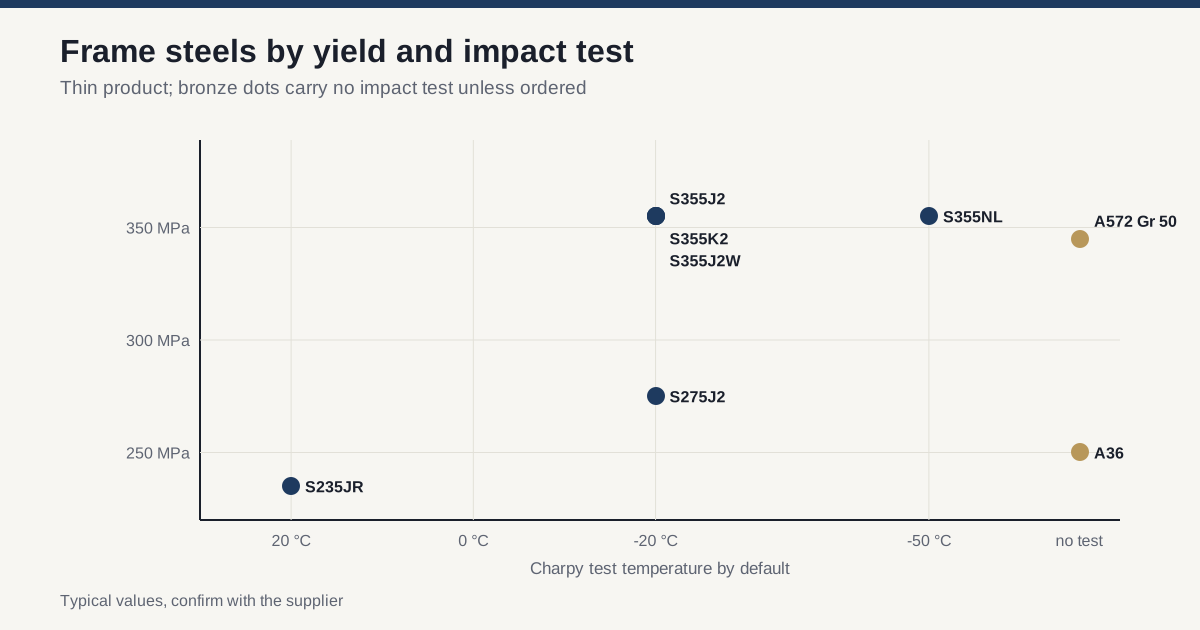
Three ways to sort the grades
By strength class. The 235 to 250 MPa class (A36, S235) suits light frames where stiffness, not strength, governs. The 345 to 355 MPa class (A572 Gr 50, A992, S355) is the working class for heavy frames, with detail pages on S355 and A572 Grade 50: the same section has about 40% more yield capacity than in A36, usually for a small price difference. Higher grades (S460, A572 Gr 60 and 65, quenched and tempered S690) save weight on mobile equipment and cranes but need tighter welding control.
By toughness. The impact sub-grade is the second half of the name in the EN system (JR, J0, J2, K2, then N/NL and M/ML in EN 10025-3 and -4). ASTM grades carry no impact test unless the order adds a supplementary requirement. A frame for outdoor service in a cold climate needs a grade tested at or below its design temperature, chosen with EN 1993-1-10 or the design code in use. The buyer article on Charpy impact requirements for cold-climate frames covers the selection.
By special property. Weathering grades (A588, S355J2W) form a protective patina and are left unpainted where the climate allows; see weathering steel for outdoor equipment frames. Through-thickness grades (EN 10164 Z-classes) resist lamellar tearing; see Z25 and Z35 steel. Stainless grades (304, 316) are a separate family for process and food plant skids, covered in stainless skid frames, 304 vs 316.
How grade choice interacts with the rest of the drawing
| Decision | Why the grade matters |
|---|---|
| Welding code and procedures | AWS D1.1 prequalifies listed ASTM grades; EN grades usually need a PQR under D1.1. See AWS D1.1 in plain language |
| Execution class | Higher strength grades can push a component to a higher EN 1090 class. See EN 1090 execution classes |
| Preheat | Higher CEV and thicker plate raise preheat. See preheat and interpass temperature |
| Machining | Plate with a stable, normalized structure moves less after machining |
| Certificates | EN 10204 3.1 is the usual minimum; 3.2 for class or offshore work. See 3.1 vs 3.2 |
| Market rules | Some markets ask for the melting country on the certificate; see the destinations hub |
Equivalents and substitution
Cross-reference tables pair A36 with S235JR, A572 Gr 50 with S355 and JIS SM490 or GB/T 1591 Q355 with the 355 class. They are close, not identical: thickness bands, impact tests, chemistry limits and tolerances differ. Write one grade on the drawing and the rule “alternatives only with written approval of the engineer of record”. A shop that proposes a substitute then sends the mill certificate, and the engineer decides. The plate designation system is explained on reading EN 10025 plate designations, and the short comparison of the four most common grades on A36, A572 and S355 for heavy weldments.
What to write on the RFQ
- Full grade with sub-grade and delivery condition, for example S355J2+N or A572 Gr 50 with a Charpy supplementary requirement.
- Z-class where through-thickness loading applies.
- Certificate type and whether the melting country must be shown.
- The thickest plate and the design temperature.
- The substitution rule.
When the material line is settled, send the drawing and we reply within 24 business hours.
Frequently asked questions
- Which structural steel grade is most common for heavy frames?
- S355 on European drawings and A572 Grade 50 (with A992 for wide-flange shapes) on US drawings. Both have a minimum yield of about 345 to 355 MPa in thin product and weld well with standard procedures.
- Is A36 the same as S235?
- They are close: A36 has a minimum yield of 250 MPa and S235 of 235 MPa. Chemistry, impact testing and tolerances differ, so treat them as alternatives only with the engineer's approval.
- When does a frame need a Z-grade?
- When a plate is loaded through its thickness by a welded joint, such as a lug on a flange or a column on a thick base plate, and the joint is restrained. EN 10164 classes Z15, Z25 and Z35 give tested through-thickness ductility.
- What does the impact sub-grade mean?
- It is the Charpy V-notch test temperature and minimum energy. In EN 10025-2, JR is tested at +20 °C, J0 at 0 °C and J2 and K2 at -20 °C. Lower temperatures need the fine-grain grades of EN 10025-3 and -4.
- SteelConstruction.info, steel material properties
- ASTM A572/A572M-25 (ASTM store)
- CEN, European standards catalogue
- Wikipedia, weathering steel
Standards and rules are cited as references. They are not claims about heavyframes.com or any shop. Confirm the edition and current status with the issuing body.