Stainless Steel Skid Frames: 304 vs 316 for Process and Food Plants
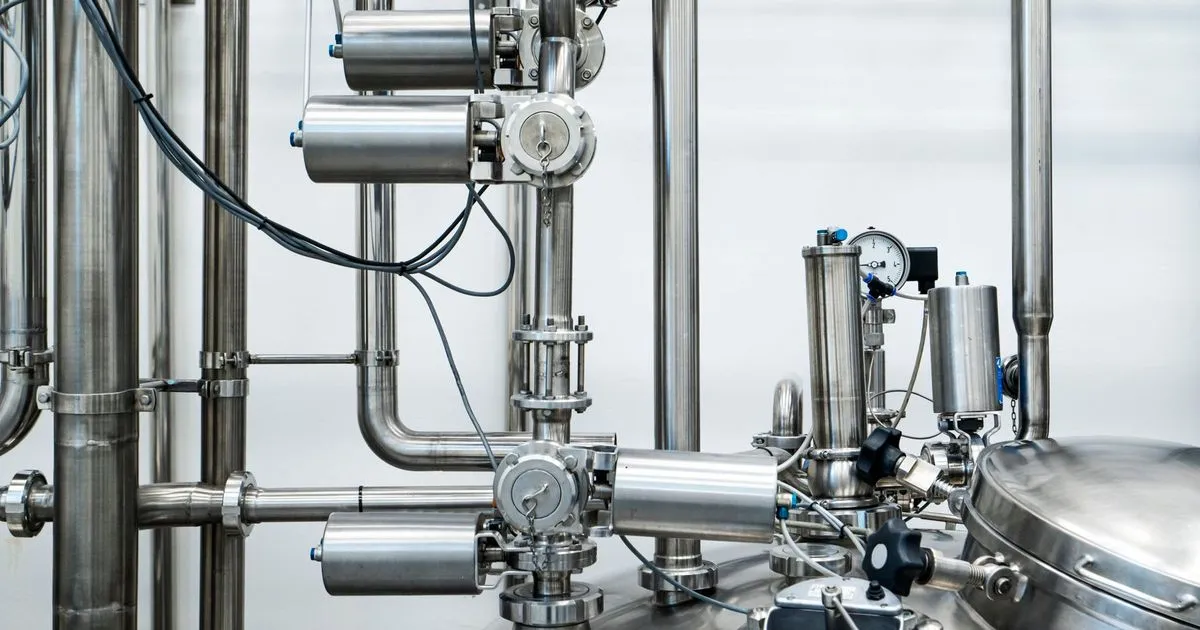
Process equipment often arrives on a skid: a steel frame that carries tanks, pumps, valves and pipework and lets the whole package be built, tested and shipped as one unit. In a food, beverage or pharmaceutical plant, that frame sits in the same washdown environment as the equipment it carries. A frame in carbon steel and paint rusts at the first chip. A frame in stainless steel does not, provided the right grade is chosen and the shop fabricates it correctly.
The choice that comes up most often is 304 or 316. They look identical, they weld similarly and 316 costs more. This article explains where the difference matters, what changes in fabrication and what to write on the order.
What separates 304 from 316
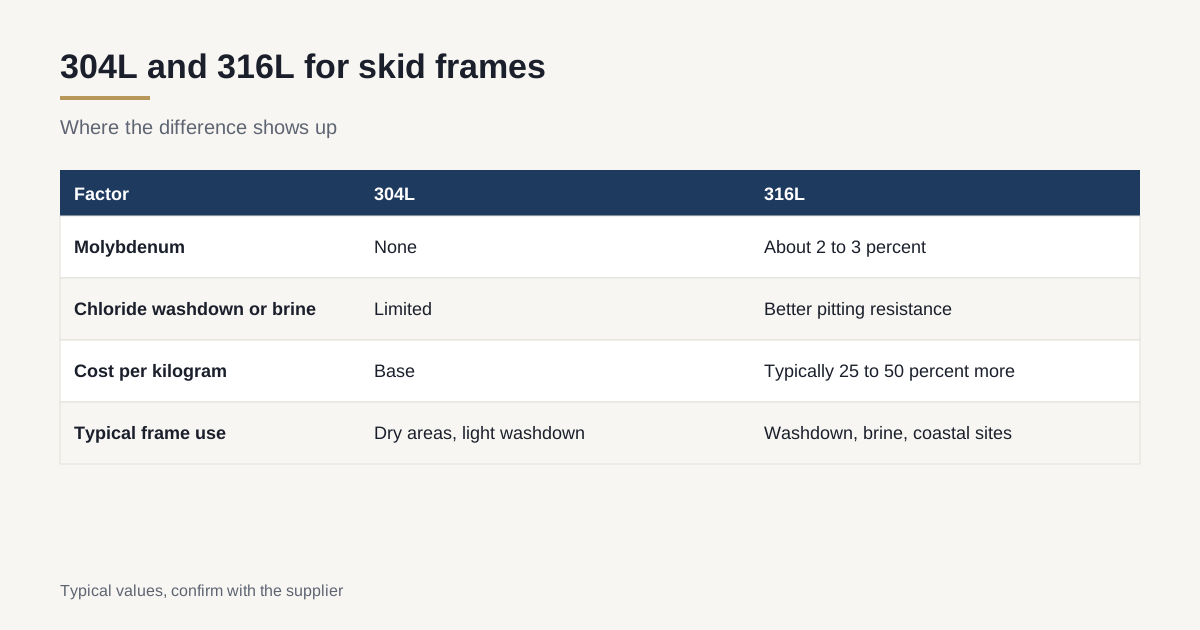
Both are austenitic stainless steels, based on chromium and nickel. Chromium forms the thin, invisible oxide film that protects the surface. The difference is molybdenum: 316 contains about 2 to 3 percent, and 304 contains none. Molybdenum improves resistance to pitting and crevice corrosion in chloride-bearing environments.
| Property | 304 | 316 |
|---|---|---|
| Typical chromium | 18 to 20 percent | 16 to 18 percent |
| Typical nickel | 8 to 10.5 percent | 10 to 14 percent |
| Molybdenum | None | About 2 to 3 percent |
| Pitting resistance, relative | Good in mild environments | Better in chlorides |
| Cost per kilogram | Lower | Typically 25 to 50 percent higher |
| Common low-carbon version | 304L | 316L |
| Typical frame use | Dry areas, light washdown | Washdown, chlorides, product-contact zones |
The cost gap changes with nickel and molybdenum prices, so treat the percentage as a ballpark and ask for a current quote on both.
Where chlorides decide the grade
Chlorides are the enemy of austenitic stainless steel. They attack the oxide film locally and cause pitting, and in crevices they can cause deep corrosion under deposits. Sources in a plant include:
- Cleaning and sanitising chemicals based on chlorine or hypochlorite.
- Brine and salty products, such as pickles, sauces, cured meat and dairy cheese brines.
- Coastal air in plants near the sea.
- Process water with chloride content.
304 handles most dry and lightly washed areas. 316 is the safer choice where chlorinated washdown is routine, where brine or salty product splashes on the frame, or where the plant is close to the coast. A frame that is washed daily with a chlorine-based cleaner and left wet overnight is a 316 application, even if the equipment on it is 304.
There is also a temperature effect. Austenitic stainless steels in contact with chlorides at elevated temperatures, roughly above 60 degrees Celsius, can suffer stress corrosion cracking. This matters for frames close to hot process lines and steam. In those cases, a specialist should review the grade, and duplex stainless steels are sometimes chosen instead.
Weld sensitisation and the L grades
Welding heats the stainless steel next to the weld into a range where chromium can combine with carbon and form carbides at the grain boundaries. The metal next to the weld loses chromium and corrodes preferentially, a condition called sensitisation. The remedy is low carbon content.
304L and 316L carry a maximum carbon of 0.03 percent, against up to 0.08 percent in the standard grades. They are the usual choice for welded frames because they resist sensitisation. Many mills sell dual-certified 304 and 304L or 316 and 316L material that meets both. If the order says only “316”, ask the shop to confirm the L grade or the dual certificate.
Filler metal matches the base metal: 308L filler for 304L and 316L filler for 316L. Joints between stainless and carbon steel, such as a stainless frame bolted to a carbon steel baseplate by welding, use an over-alloyed filler such as 309L. The details of weld procedures and their records are covered in the article on reading a WPS and PQR before ordering.
Hygienic frame design
In food and pharmaceutical plants, the frame design matters as much as the grade. Cleanability decides whether the frame passes an audit.
- Sealed hollow sections. Tubes should be closed with welded end caps or continuous seals so that liquid and bacteria cannot enter. Open-ended tube legs are a common rejection.
- Continuous welds on joints, not intermittent tack or stitch welds that leave crevices. Welds on food-side surfaces are ground smooth.
- No flat horizontal surfaces where liquid can pool. Slope tops or use angled sections.
- Rounded corners and a smooth finish. Sharp internal corners trap dirt.
- Adjustable feet that lift the frame off the floor for cleaning, with sealed or hygienic foot design.
- Stainless fasteners throughout, never carbon steel bolts or screws.
- Gaps and gaskets at joints where parts meet, to avoid crevices.
Specify the finish too. Typical frame finishes are mill finish 2B, brushed finish such as number 4 or an electropolished finish for the most demanding applications. Hygienic standards often call for a surface roughness of Ra 0.8 micrometres or finer on product-contact surfaces, while structural frames are usually less strict. State the requirement on the drawing and not only in the specification.
For the pan, drain and containment side of a stainless skid, see drip pans, containment and drains.
Fabrication practice: keeping stainless clean
Stainless steel does not rust unless it is contaminated or damaged, and the most common contamination comes from the shop itself.
- Dedicated tools. Grinding discs, wire brushes and clamps used on carbon steel leave iron particles that rust on the stainless surface. A shop that does stainless work properly keeps separate tools, or at least separate discs and brushes, marked for stainless only.
- Separate work areas or protective covers on tables and racks, to avoid carbon steel dust landing on stainless.
- Heat tint removal. The coloured oxide layer around a weld reduces corrosion resistance. It must be removed by pickling, by electrochemical cleaning or by mechanical methods followed by passivation.
- Passivation. A nitric or citric acid treatment restores the protective film. Standards such as ASTM A967 and A380 describe it.
- Protective film on sheet and plate kept in place as long as possible.
Ask the shop how it separates stainless and carbon steel work. A quick look at the shop floor tells a lot: shared grinding stations and rusty tables are a bad sign.
Distortion and heat control
Austenitic stainless steel expands about 40 percent more than carbon steel when heated, and conducts heat only about a third as well. Heat stays near the weld and distorts the frame more readily. Practical measures include lower heat input, skip welding sequences, good clamping and, on tube frames, back purging with inert gas to keep the inside of the weld bright and free of oxide. The principles in the article on welding distortion control for heavy plate apply, with tighter heat input limits.
Identification and certificates
Stainless grades look the same, and mix-ups happen in stockyards and shops. Two controls prevent them:
- Mill certificates showing the grade, composition and heat number, usually type 3.1 under EN 10204. See the article on EN 10204 3.1 and 3.2 certificates.
- Positive material identification. A handheld analyser checks the composition of parts on the frame. For 316 frames, this confirms molybdenum is present. It is quick and inexpensive and is often added to the order for critical equipment.
Heat numbers should be kept through cutting and marked on offcuts that are reused.
Cost and when to downgrade or upgrade
The material cost of a stainless frame is only part of the price. Fabrication hours, finishing and passivation often equal or exceed the cost of the metal. Switching from 316 to 304 saves less than the headline price gap suggests, and a failed 304 frame costs far more than the saving. A short rule of thumb:
- Dry and lightly washed areas: 304L is usually enough.
- Routine chlorinated washdown, brines, coastal sites: 316L.
- Hot chloride exposure: ask for a specialist review, and consider duplex.
- Not in contact with water or chemicals: painted or galvanised carbon steel may suffice, as discussed in the article on surface finish systems for structural steel.
What to write on the order
- Grade and standard: for example EN 1.4404 (316L) or ASTM A240 316L plate, with the L grade stated.
- Product forms: tube, plate, angle, each to its own standard.
- Weld requirements: filler type, continuous seal welds and ground smooth where food-side.
- Cleaning: heat tint removal and passivation to a named standard.
- Finish: surface roughness or finish class.
- Identification: mill certificates and PMI if required.
- Shop practice: dedicated stainless tools and storage.
Checklist before awarding the work
- Plant washdown and chloride exposure reviewed.
- Grade chosen with the L version for welded parts.
- Hygienic design points checked on the drawing.
- Shop separates stainless from carbon steel work.
- Cleaning and passivation steps agreed.
- Certificates and PMI planned.
If you have a stainless skid and need shops that fabricate it in dedicated stainless areas, send the drawing with the grade and finish requirements. We reply within 24 business hours.