Structural Bolts for Heavy Frames: A325, A490 and Grade 10.9 Compared
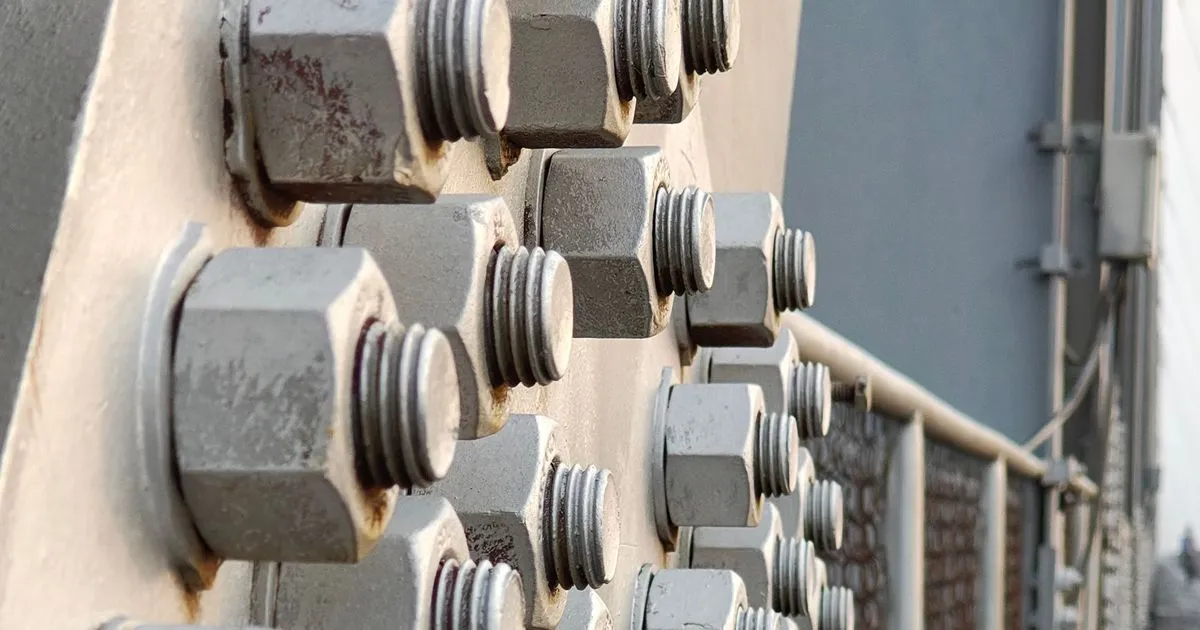
Split frames, bolted skids and field-assembled structures all rely on a small, cheap part: the bolt. A joint that is designed to carry a large load by friction between plates holds only if the bolts are the right class, are tightened to the right tension and are made of steel that will not crack. Ordering “high-strength bolts” without naming the class leaves each of those open.
This article compares the common structural bolt families used on heavy frames, ASTM A325, ASTM A490 and ISO and EN grade 10.9, and covers the points that matter on an order: strength, coating, pretension and traceability.
The three families
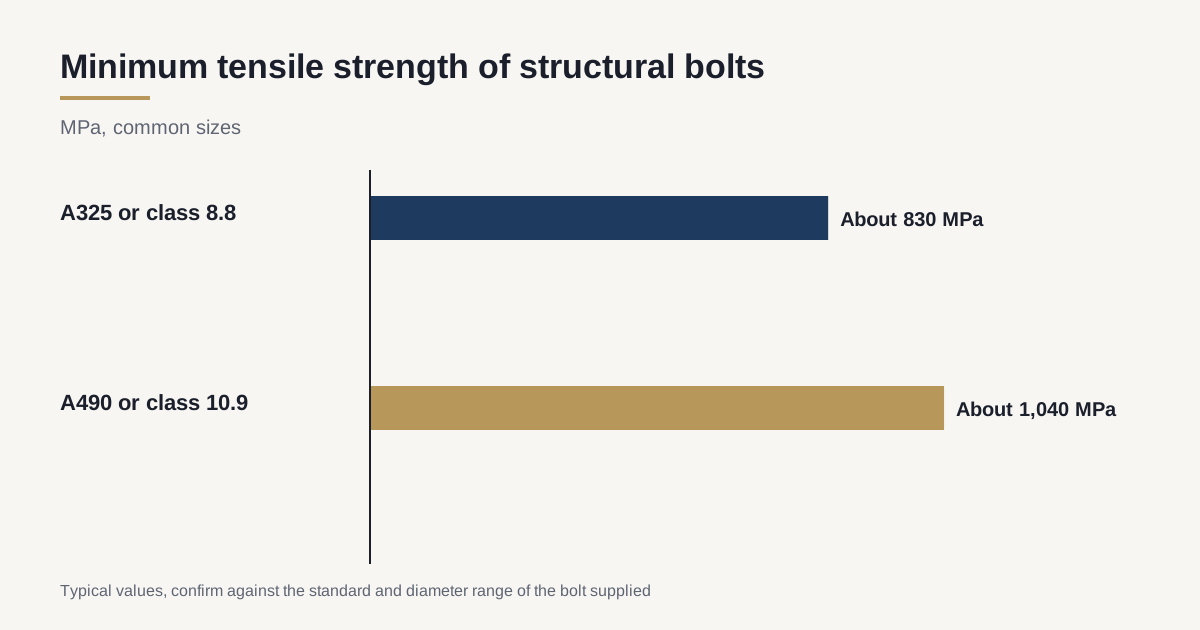
ASTM A325 is the standard high-strength structural bolt in US practice. It is a medium-carbon, quenched and tempered steel bolt with a minimum tensile strength of about 120 ksi, roughly 830 MPa, for diameters up to 1 inch. Type 1 is the common version and Type 3 is a weathering steel version for unpainted weathering steel frames.
ASTM A490 is stronger, with a tensile strength range of about 150 to 173 ksi, roughly 1,040 to 1,190 MPa. It is made from alloy steel. It is used where higher clamp load is needed in a smaller joint.
ISO property class 10.9 is the closest metric equivalent to A490, with a nominal tensile strength of 1,000 MPa and a minimum of 1,040 MPa for the common structural sizes, and class 8.8 is the rough metric equivalent of A325. In Europe, preloaded bolt assemblies follow EN 14399, and non-preloaded structural bolts follow EN 15048. In North America, the ASTM bolt standards have been grouped under ASTM F3125, where A325 and A490 appear as grades of the same standard.
| Property | A325 or class 8.8 | A490 or class 10.9 |
|---|---|---|
| Minimum tensile strength | About 830 MPa (120 ksi) | About 1,040 MPa (150 ksi) |
| Common name | High-strength | Very high-strength |
| Hot-dip galvanising | Allowed with care | Not allowed for A490, restricted for 10.9 |
| Typical use | General structural connections | High-load connections, compact joints |
| Reuse | Limited, not if galvanised | Not permitted |
Why A490 and 10.9 are restricted on coating
The higher the strength of a steel bolt, the more sensitive it is to hydrogen. Hot-dip galvanising involves acid pickling before the zinc bath, which can introduce hydrogen into the steel. In very high-strength bolts, that hydrogen can lead to delayed cracking under load, often weeks or months after installation.
For this reason, ASTM A490 bolts are not allowed to be hot-dip galvanised. Class 10.9 bolts also carry warnings in EN ISO 10684 and related standards for hot-dip galvanising, and many specifications restrict it. If a frame needs corrosion protection with very high-strength bolts, the usual options are mechanical galvanising, zinc flake coatings or plain bolts with a paint system. A325 bolts can be hot-dip galvanised, with nuts specially tapped oversize and lubricated, to accepted rules.
The coating choice for the whole frame is covered in the article on surface finish systems for structural steel, and the bolt coating needs to agree with it. On weathering steel frames, A325 Type 3 bolts match the plate, as discussed in the article on weathering steel for outdoor frames.
Pretension: what the bolt must actually do
High-strength structural bolts in slip-critical joints work by clamping. The bolt is tightened until it stretches slightly and holds the plates together with a defined clamp force. Loads pass between the plates by friction, not through the bolt shank. If the bolt is under-tightened, the joint can slip. If it is over-tightened, it can yield or fracture.
Typical minimum pretension values from US practice for common sizes are:
| Bolt diameter | A325 minimum pretension | A490 minimum pretension |
|---|---|---|
| 3/4 inch | 28 kips (125 kN) | 35 kips (156 kN) |
| 7/8 inch | 39 kips (173 kN) | 49 kips (218 kN) |
| 1 inch | 51 kips (227 kN) | 64 kips (285 kN) |
In metric sizes, the same logic gives about 205 kN for an M24 A325M bolt and 257 kN for an M24 A490M bolt. Under EN 14399, the preload is calculated as 0.7 times the tensile strength times the stress area, which gives about 198 kN for an M24 class 8.8 bolt and 247 kN for an M24 class 10.9 bolt. The figures above are typical, and the governing code and the engineer of record fix the real numbers.
How pretension is achieved
Several methods are accepted, and the choice affects cost and inspection:
- Turn-of-nut method. After snugging the joint, each nut is turned a set fraction of a turn, depending on bolt length. It is simple and does not rely on a calibrated wrench.
- Calibrated wrench method. A torque wrench is calibrated daily against a sample bolt in a tension measuring device.
- Twist-off bolts. The bolt has a splined end that snaps off when the correct torque is reached. This allows easy visual inspection. Common standards are ASTM F1852 and F2280.
- Direct tension indicators. Washers with small protrusions that flatten under load to a set gap.
For site work, twist-off bolts and direct tension indicators reduce the chance of missing a bolt and make inspection easy. Whatever method is chosen, the shop and the installer must use the same one, and the drawing note should state it.
Faying surfaces and slip resistance
In a slip-critical joint, the surface of the plates under the bolts matters as much as the bolts. Paint, oil, galvanising and mill scale change the friction.
- Class A surfaces, such as clean mill scale or unpainted blasted steel with Class A coating, give a slip coefficient of about 0.30.
- Class B surfaces, such as blast-cleaned unpainted steel, give about 0.50.
- Galvanised or painted surfaces give lower values unless tested.
A split frame joint designed around a Class B surface will slip if the shop paints the contact faces. Write it on the drawing: which faces are to be left bare, which coatings are permitted on the faying surfaces and which are not. The design logic for bolted splits is covered in the article on split-and-bolt frame design.
Bolts, nuts and washers as an assembly
Structural bolts are designed as assemblies: bolt, nut and washer from the same system. Mixing parts from different standards or manufacturers can change the torque-tension relationship and the strength of the thread engagement. Typical rules:
- Use the nut grade specified for the bolt: for example A563 heavy hex nuts for A325 and A490, with grade DH for A490.
- Use hardened washers where the standard requires them.
- Use lubricated and coated parts from one supplier lot in one joint.
- Do not substitute grade 8.8 parts for A325 or 10.9 parts for A490 without engineering approval, because dimensions and pretension values differ.
Reuse and storage
A490 bolts must not be reused. Galvanised A325 bolts must not be reused. Other A325 bolts can be reused only under strict conditions that most project specifications forbid. The reason is that tightening stretches the bolt and changes the thread, and a reused bolt can reach the target torque with less actual tension.
Keep bolts in their original kegs until use, dry and in lot order. Rust and dirt change friction and give false torque readings. Lot traceability is part of the paperwork, as described below.
Traceability and certificates
Structural bolts should be identified. The head carries a manufacturer mark and the grade mark, and the lot is recorded on the delivery documents. For export orders, ask for:
- Manufacturer test reports for each lot, listing tensile, hardness and coating checks.
- Rotational capacity test results for galvanised assemblies, where applicable.
- Marking on every bolt head and nut, as required by the standard.
- Certificate type. The ideas in the article on EN 10204 3.1 and 3.2 certificates apply to fasteners too.
Counterfeit and unmarked bolts are a known risk in the structural fastener market. Buy from known manufacturers and check head marks on arrival.
What to write on the order
- Standard and grade, for example ASTM F3125 Grade A325 Type 1, or EN 14399-4 class 10.9 HV.
- Coating, and a note that A490 and 10.9 are not hot-dip galvanised unless the engineer approves.
- Nut and washer standard and grade.
- Pretension method and the required minimum tension.
- Faying surface requirement and coating limits.
- Quantity with spares, typically 5 to 10 percent extra for site.
- Documentation: test reports by lot and head marking.
Checklist before ordering
- Bolt class chosen from the connection design, not by habit.
- Coating compatible with the bolt strength.
- Pretension and installation method written down.
- Contact surfaces specified and kept free of paint where required.
- Nuts and washers matched to the bolt standard.
- Lots traceable, with test reports.
- No reuse of A490 or galvanised bolts.
If your frame is bolted and you want the bolt specification checked against the design and shipping plan, send the drawing. We reply within 24 business hours.