Home / Frame types
Reference hubTypes of Heavy Steel Frames: Skids, Base Frames, Structures, Modules
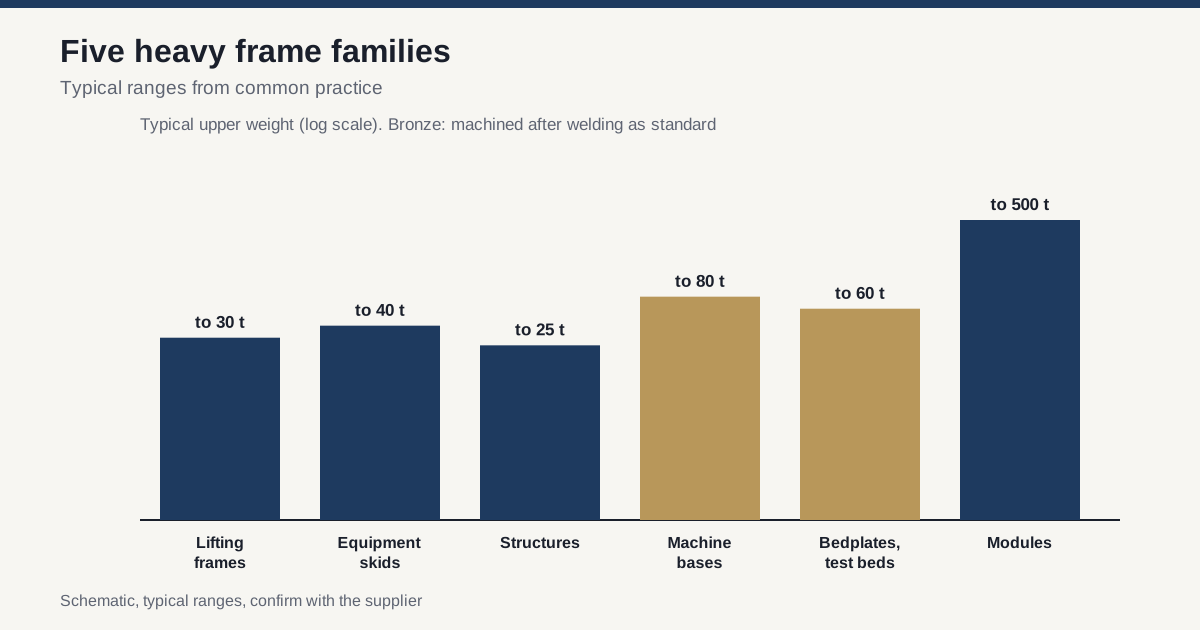
Heavy steel frame fabrication covers welded structures of a few tonnes up to 50 t or more that are too large or too demanding for a jobbing machine shop and too machined or too documented for a general steel erector. They sort into five families: equipment skids; machine bases and bedplates; structures (racks, platforms, crane and conveyor steel); modules; lifting and handling frames. Each family has its own governing load case, its own tolerance logic and its own codes. The matrix below is the map; the pages of this library go into each.
| Type | Typical size and weight | Governing load case | Key tolerance | Codes usually named | Machining after welding | Transport |
|---|---|---|---|---|---|---|
| Equipment skid | 2 to 12 m, 2 to 40 t | Lift and transport, then alignment | Pad flatness and coplanarity | AWS D1.1 or EN 1090-2 EXC2, ISO 12944 | Pads, often | Container, flat rack or breakbulk |
| Machine base or bed | 2 to 15 m, 5 to 80 t | Stiffness and stability | Flatness of rails and pads per metre | ISO 3834, client spec, stress relief | Yes, after stress relief | Breakbulk, often split |
| Bedplate or test bed | 3 to 12 m, 10 to 60 t | Stiffness, vibration | Flatness, T-slot accuracy | Client spec, ISO 3834 | Yes, large gantry mill | Breakbulk |
| Structure (pipe rack, platform, conveyor, crane) | Members to 24 m | Static or fatigue loads | EN 1090-2 or AISC 303 tolerances | EN 1090-2 EXC2 or EXC3, AWS D1.1, AISC | Bolt faces only | Loose members, bundled |
| Process module | 6 to 30 m, 20 to 500 t | Lift, transport, pipe loads | Interface points, levels | EN 1090-2 or AISC, client spec, class rules offshore | Rarely | Breakbulk or heavy-lift vessel |
| Lifting and handling frame | 1 to 20 m, to 30 t | Lift with design factors | Pin hole positions | ASME BTH-1, EN 13155, client lifting spec | Pin holes | Container or flat rack |
Typical ranges from common practice; each project sets its own figures.
Family 1: equipment skids
A skid carries a package (pump, compressor, dosing set, filter, switchgear) and is designed to be lifted and moved with the equipment on it. The lift and the transport are usually the governing cases, and the equipment alignment is the acceptance test. Skids range from simple beam frames to bunded, decked and piped packages. The full reference is on equipment skids, and the buyer article on steel skid fabrication gives the purchasing view.
Family 2: machine bases, beds and bedplates
These frames exist to hold geometry. A machine tool bed, a press frame, a wind turbine bedplate or an engine test bed is judged by flatness and stiffness, not by strength alone. The production route is fixed: weld, stress relieve, machine, then protect the machined faces. A shop’s oven length and the travel of its largest mill decide whether it can quote. See weldment vs casting for machine bases, stress relief of welded machine bases and engine test bed and dynamometer bedplates.
Family 3: structures
Pipe racks, platforms, conveyor galleries, transfer towers, crane runways and gantry structures. They are built as many members, bolted on site, and judged by the structural code: fit, tolerances, weld quality, coating. Execution class matters here more than anywhere; see EN 1090 execution classes. Fatigue governs where a structure carries cranes, conveyors or vibrating screens, and the welding code’s cyclic rules then apply; see AWS D1.1 in plain language.
Family 4: modules
A module is a structure with equipment, piping and cable installed, built to be moved as one large piece. It combines the structural rules of family 3 with the lift and transport rules of family 1 at a larger scale. Module size is set by the route to site: road limits, port cranes and vessels. The buyer articles on modular skid packages and pipe rack modules and split points cover it.
Family 5: lifting and handling frames
Spreader beams, lifting frames, transport frames and assembly jigs. They are designed to a lifting code with explicit design factors and are proof load tested. The buyer article on spreader beam fabrication to ASME BTH-1 explains the categories, and proof load testing of lifting points the test.
Three decisions that cut across all types
Bolted or welded connections
Site-bolted connections make transport and erection simpler and let parts be galvanized in smaller kettles; welded connections give stiffness and a cleaner load path. Most heavy frames mix both: shop-welded assemblies joined by bolted splices. The trade-off is laid out in bolted vs welded connections.
Split and bolt for shipping
A frame that exceeds the shipping envelope is designed with split points: machined or bolted joints placed where the stress is low and the pieces fit the route. It is far cheaper to design the split than to cut a finished frame. See split-and-bolt frame design and the shipping envelope checker.
Welding process
Thick sections and long seams favour high-deposition processes (submerged arc, flux-cored), while positional work and short welds stay with stick or flux-cored. The process changes cost, distortion and the procedure qualification needed; see choosing an arc welding process for heavy sections.
Steel, codes and markets for each type
The material choice for every family starts in the structural steel grades hub. The codes that sit on the drawing are gathered on the codes hub, and the market rules for where the frame will be installed on the destinations hub.
What to put on the RFQ, by type
| Type | Must be on the RFQ |
|---|---|
| Skid | Equipment weights and centre of gravity, lift points, pad tolerance, coating |
| Machine base or bedplate | Flatness per metre and overall, stress relief method, machining datum, protection of machined faces |
| Structure | Code and execution class or loading condition, coating, connection type, erection marks |
| Module | Envelope and weight limits, split points, interface list, test scope |
| Lifting frame | Lifting code and category, rated load, proof load, certificates |
Whatever the type, send the drawing and the destination and we match it with shops whose crane, oven and machining capacity fit. We reply within 24 business hours.
Frequently asked questions
- What is the difference between a skid and a base frame?
- A skid carries a package of equipment and is built to be lifted and moved as one unit, often with a deck, drip pan and piping. A base frame carries one machine or a machine train and is judged mainly by stiffness and the flatness of its mounting pads. Many projects use the words loosely, so describe the function on the RFQ.
- Which frame types need machining after welding?
- Machine bases, test beds, bedplates and skids for rotating equipment usually do. Structures, pipe racks and most modules do not, apart from bolted connection faces in some cases.
- How heavy is a heavy frame?
- There is no formal limit. In practice the category starts at a few tonnes, where the crane, oven and machining envelope of a shop start to decide who can build it, and runs to single pieces of 50 t or more.
- When should a frame be split for shipping?
- When any dimension or the weight exceeds what the transport route can carry without special permits or vessels. The split point should be designed in before fabrication, with machined or bolted joints, rather than cut afterwards.
- AWS, D1.1/D1.1M:2025 Structural Welding Code, Steel
- Wikipedia, EN 1090
- SteelConstruction.info, steel material properties
Standards and rules are cited as references. They are not claims about heavyframes.com or any shop. Confirm the edition and current status with the issuing body.