AR400 and Hardox Wear Plate in Heavy Equipment Frames
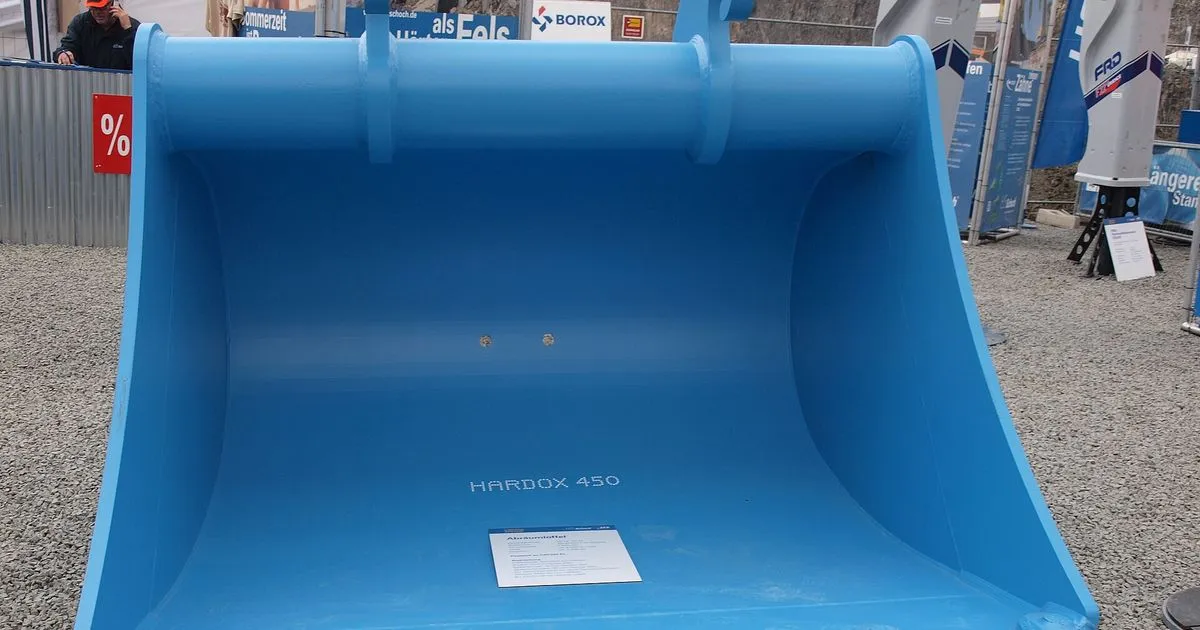
Chutes, hoppers, bucket floors, crusher liners and truck bodies share one problem: material moving across steel wears it away. Mild steel loses thickness quickly under rock, ore or gravel. Abrasion-resistant plate, sold as AR400, AR450, AR500 or under brand names such as Hardox, lasts several times longer in the same service.
It also fabricates differently. A shop that welds A36 every day can ruin an expensive AR plate by treating it the same way. This guide explains the grades, where wear plate belongs in a frame and the cutting, welding and bending limits a buyer should ask about.
What the names mean
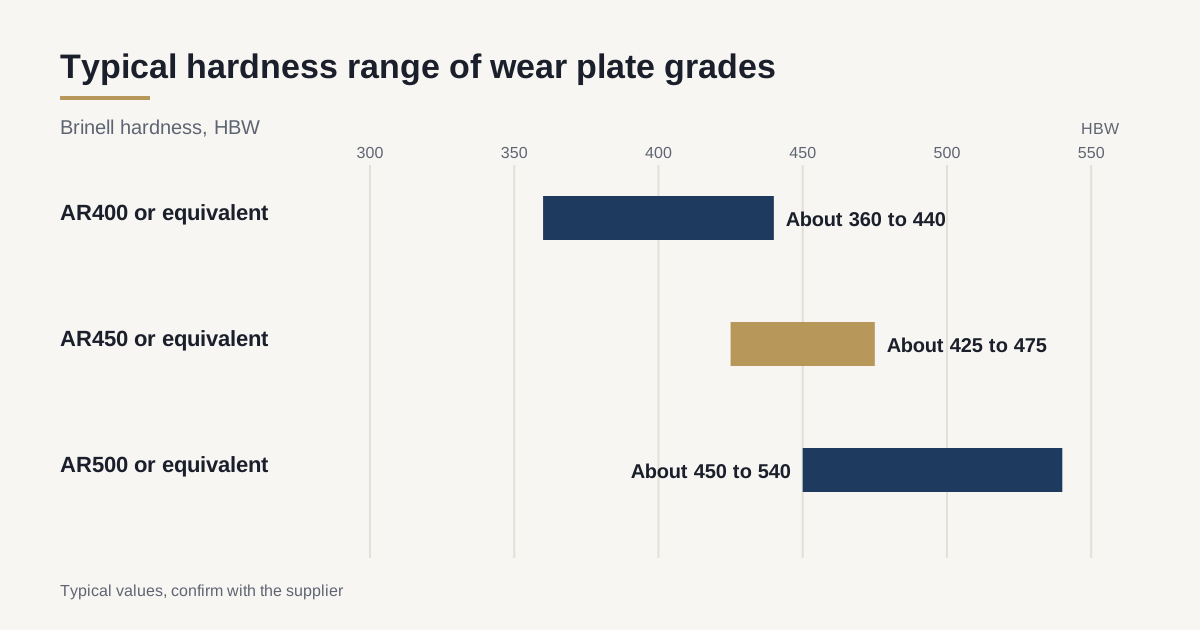
AR stands for abrasion resistant. The number is the nominal Brinell hardness. AR400 is about 400 HBW, AR450 about 450 and AR500 about 500. Higher hardness generally means longer life against sliding abrasion, and lower toughness and formability.
There is an important point about names. AR400 is a generic class, not a single standard. Each steel mill makes its own version with its own chemistry and tolerance. Hardox is a registered brand of one producer, with its own grades such as 400, 450 and 500 and its own guaranteed properties. Other mills sell similar products under other names, and in Asia the NM400 and NM450 designations are common. They are made by quenching and tempering, and they are not interchangeable without checking the data sheet.
| Grade | Typical hardness range, HBW | Typical use |
|---|---|---|
| AR400 or equivalent | About 360 to 440 | General wear liners, chutes, bucket sides |
| AR450 or equivalent | About 425 to 475 | Heavier abrasion, crusher parts, truck beds |
| AR500 or equivalent | About 450 to 540 | Severe sliding abrasion, cutting edges |
Quoted figures are typical, and the actual range depends on the producer. The mill certificate for the plate in your order should show the real hardness.
Where wear plate belongs in a frame
Wear plate is a surface material. Its hardness makes it very good at resisting loss of thickness and much less forgiving as a primary structural member. The usual frame design puts it in three roles:
- Liner: plate bolted or welded onto a structural body, replaceable when worn.
- Wear surface: a thin layer of AR over a structural base, for example a bucket floor or chute bed.
- Self-supporting body: a thin-walled dump body or bucket made from AR plate that carries load as well as resisting wear, as in many truck bodies and excavator buckets.
For fabricated machine frames, the best-practice split is to keep the main structure in a tough structural steel such as S355 or A572 Gr 50 and cover the contact surfaces with AR. That keeps the weld details in familiar material and lets the liners be changed. See the comparison of structural grades in the article on steel grades for heavy weldments.
Cutting AR plate
AR plate can be cut by plasma, laser, oxy-fuel and waterjet.
- Plasma and laser work well on thinner and medium plates, and leave a narrow heat-affected zone.
- Oxy-fuel is possible on thick plate, but needs preheat to avoid edge cracking, often in the range of 100 to 200 degrees Celsius depending on thickness and grade.
- Waterjet has no heat-affected zone and suits thick plate and delicate parts, at higher cost.
The producer’s data sheet gives the preheat for each grade and thickness. Edges that will be welded should be ground back to remove the hardened layer. The comparison of cutting processes is in the article on cutting thick plate for heavy frames.
Welding AR plate
Welding is where most problems start. AR plate has a high carbon equivalent compared with structural steel, and its strength comes from its quenched and tempered structure. Two risks follow: cold cracking in the heat-affected zone, and softening of the plate if too much heat goes in.
Typical practice:
- Preheat to the producer’s recommendation. Typical values are from about 50 degrees Celsius on thin plate to 150 to 200 degrees on thick plate. The principles are in the article on preheat and interpass temperature.
- Low-hydrogen consumables. Solid wire and low-hydrogen electrodes, stored dry.
- Limit the interpass temperature. Producers commonly set a maximum around 225 degrees Celsius to protect the plate’s properties.
- Limit heat input. Faster travel and stringer beads reduce the soft zone beside the weld.
- Choose filler by role. For structural joints, strength-matched filler gives full strength but is less tolerant of cracking. For joints between AR and structural steel, a lower-strength filler is often used to reduce the crack risk, and for liner attachment, austenitic stainless filler is a common choice because it stays tough and tolerates hydrogen.
Do not weld wear plate in a way that places a hard heat-affected zone in a high-tension fatigue location. Details such as plug welds, slot welds and bolted liners avoid long continuous welds in the wear plate itself.
Heat treatment after welding is normally not allowed. The temper of the plate sets its hardness, and heating above its tempering temperature, typically around 250 degrees Celsius for the common grades, permanently softens it. This also rules out normal thermal stress relief. Machine bases and long-life frames that need stress relief should keep wear plate out of the stress-relieved assembly and bolt it on afterwards.
Bending and forming
Wear plate is harder to bend. A typical cold bending rule is a minimum inside radius of about 3 to 4 times the thickness for AR400 and more, such as 4 to 6 times, for AR450 and AR500, with the bend line across the rolling direction. Springback is high. Producers publish minimum radius tables by thickness and grade. Bends that are too tight crack on the outside face.
Hot forming is not recommended because it destroys the hardness. The general approach to cold forming is discussed in the article on plate rolling and press brake forming.
Drilling, machining and bolting
AR plate is hard to drill and machine. Carbide tooling, rigid setups and slow speeds are standard. Many designs avoid machining altogether by cutting holes with plasma or waterjet and using countersunk bolts with a flush head, so the bolt head wears with the plate. Where machining is unavoidable, allow more time and expect faster tool wear.
Wear life and the right grade
Higher hardness does not always give proportionally longer life. Impact abrasion, such as large rock falling onto a bucket floor, can crack very hard plate. Sliding abrasion by sand and gravel generally favours higher hardness. The rule of thumb many designers use is to start from AR400 or AR450 for mixed service and move up to AR500 only for severe sliding abrasion with little impact.
Plate thickness is another lever. Doubling the thickness doubles the wear volume available before replacement, at roughly double the material cost. For parts that are difficult to replace, extra thickness is often cheaper than frequent change-outs.
What to check on the order
- Grade and producer named, for example “Hardox 450” or “AR450 per producer data sheet”. Avoid the vague phrase “AR plate”.
- Hardness range stated in HBW and verified on the mill certificate.
- Tolerance on thickness and flatness. Quenched plate can have more flatness variation than structural plate.
- Cutting and welding procedures reviewed against the producer’s recommendations.
- Bend radius and direction stated for any formed parts.
- Traceability. Heat numbers kept through cutting, and plate marked to avoid mixing with similar-looking grades.
The certificate types are explained in the article on EN 10204 3.1 versus 3.2 mill certificates. For critical wear parts, a hardness check on the delivered plate, with several readings per plate, is a low-cost confirmation.
Equivalent grades and traceability
Plate described as AR400 equivalent can range from true quenched and tempered plate to through-hardened or surface-treated products with different behaviour. Ask for the mill certificate showing chemistry, hardness and heat number, and ask which mill produced the plate. A sourcing desk should be able to trace this back to a named mill and not accept a trader’s description alone. This is part of how we assess suppliers on our how we vet page.
Checklist before ordering
- Service type reviewed: sliding abrasion, impact or both.
- Grade chosen with producer data sheet, not only a hardness number.
- Wear plate used as liner or surface where possible.
- Cutting, welding and forming steps agreed with the shop in writing.
- No post-weld heat treatment planned on assemblies that contain AR plate.
- Mill certificate and hardness check required.
If you have a bucket, chute or hopper and want a shortlist of shops that weld and form AR plate regularly, send the drawing and tell us the abrasive material and the target service life. We reply within 24 business hours.