Hydraulic Steel Gates and Penstock Sections for Hydropower
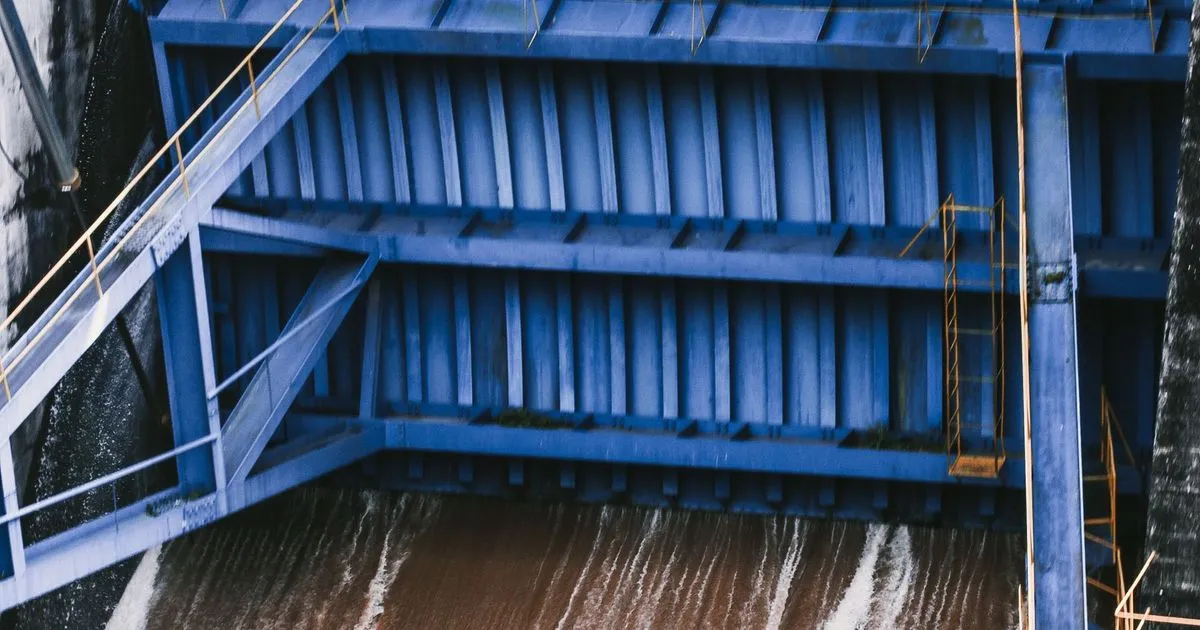
A hydropower project is mostly concrete and earth, yet its safety and output depend on steel: gates that open and close against the full head of a reservoir, and pipes that carry water to the turbines at high pressure. These are called hydraulic steel structures, and they combine heavy plate work, precision sealing surfaces and welding that must hold under pressure for decades.
Project owners, EPC contractors and gate manufacturers in North America, Europe and Australia source parts of this work from overseas fabricators. This article explains the main structures, the points that decide quality and the checks to require.
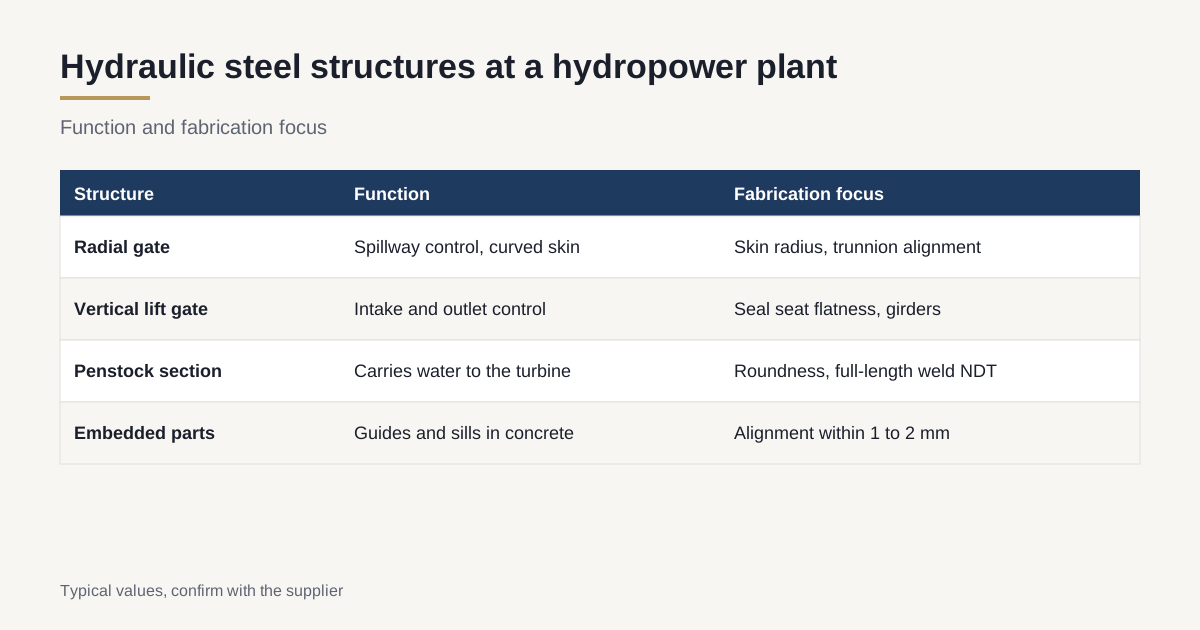
The main hydraulic steel structures
| Structure | Function | Typical construction |
|---|---|---|
| Radial (tainter) gate | Spillway control, curved skin that pivots on trunnions | Curved skin plate, horizontal girders, radial arms |
| Vertical lift gate | Intake, outlet and spillway control | Flat skin plate on girders, wheels or slides, lifted by hoist |
| Flap gate and stoplog | Overflow control and maintenance isolation | Hinged or stacked steel leaves |
| Trashrack | Keeps debris out of intakes | Bar or plate frames in sections |
| Penstock | Carries water from intake to turbine | Rolled plate shells welded into pipe sections |
| Embedded parts | Guides, sills, seal seats cast into concrete | Machined steel sections and plates |
The designer and gate manufacturer work to standards such as DIN 19704, EN 13001-type structural rules adapted to gates, USACE engineering manuals, ASCE manuals for steel penstocks and AWWA steel pipe standards. The project specification names the ones that apply.
Gate structure and what to check
A gate leaf is a stiffened plate structure. The skin plate faces the water, and horizontal girders carry the water pressure to the supports. Vertical stiffeners keep the skin from buckling between girders.
Key fabrication checks:
- Skin plate flatness or curvature. For a radial gate, the skin must follow the design radius closely so that the seal presses evenly. Check against a template or a measured surface.
- Girder straightness and alignment, because the load path and the seal geometry depend on it.
- Watertight welds. The skin-to-girder welds are continuous, with no gaps where water can enter a closed cell and corrode it from inside.
- Deflection limits. Gate girders are designed to a stiffness limit, often a fraction of the span such as 1/800, so that seals stay in contact under load. The fabricator does not set this limit but should build to the dimensions that deliver it.
- Seal seats. The surface the rubber seal touches is machined or ground flat. Seat plates are often stainless steel overlays or inserts for corrosion resistance. Flatness, straightness and finish are tightly specified.
- Wheels, rollers or slide bearings and bushings, machined to size, with alignment to the gate frame.
- Trunnion bearings and pins for radial gates, line bored where they must be coaxial. See the article on line boring bearing housings.
A gate leaf of 10 m width weighs many tonnes, and its stiffness and flatness need controlled welding sequences. The principles are in the article on welding distortion control for heavy plate.
Embedded parts: where precision meets concrete
Guide rails, sills and seal seats are cast into concrete, typically in a second pour. After that, nothing can be adjusted. The tolerances on these parts are tight, commonly within a millimetre or two for alignment and straightness over several metres, and the parts must reach the site with their measured geometry and alignment fixtures intact.
Check that the drawing shows:
- Datum and reference lines for installation.
- Straightness and flatness of guide faces.
- Anchor positions and any templates.
- Marking for installation order and location.
Fit-up in the shop before shipment avoids surprises at site. See the article on trial assembly before shipment.
Penstock sections
A penstock is a steel pipe built from rolled plate. Each section is a cylinder rolled from one or more plates, with a longitudinal seam welded, then joined to its neighbours with circumferential welds on site or in the shop.
The design pressure sets the wall thickness. High-head penstocks use thick plate, from about 20 mm to well over 50 mm in the high-pressure sections, while low-head sections can be thinner. Material is usually a weldable structural or pressure vessel steel grade, selected for strength and toughness at the design temperature.
Fabrication points:
- Plate rolling. Thick plate is rolled cold, and the shell must meet a roundness tolerance. A common requirement is that the diameter stays within about 1 percent of nominal and local flat spots stay small. See the article on plate rolling and press brake forming for the limits on bend radius, flat ends and cold work.
- Longitudinal seam welds are full-penetration and normally inspected by radiography or ultrasonic testing along their full length. Procedures and records matter, as described in the article on reading a WPS and PQR.
- Circumferential girth welds join sections and are inspected to the same standard. End preparation must be square and match the neighbouring section.
- End roundness and fit-up. Section ends often get re-rounded with internal spiders or rings during welding and shipment.
- Stiffener rings and saddles where the design needs them, with welds matched to the loading.
- Impact toughness at the design temperature, particularly for cold-climate projects. See the article on Charpy impact requirements.
- Hydrostatic or proof tests where the specification requires them.
Pressure-bearing welds in a penstock deserve inspection coverage well beyond a normal structural frame. The methods and scope are described in the article on NDT for heavy weldments. For the thickest sections, the preheat and hydrogen control principles in the article on preheat and interpass temperature apply.
Dimensional control
Fit between gate, embedded parts and concrete, and between penstock sections, depends on measurements. Typical items to measure and record:
- Gate leaf height, width and diagonal dimensions.
- Seal seat flatness and offset.
- Radial gate radius, arm length and trunnion position.
- Penstock section diameter at several positions, length and end squareness.
- Girth weld joint ends: circumference and alignment markers.
Large pieces are measured with laser trackers, total stations or tapes with calibration. The approaches are covered in the article on dimensional inspection of large frames.
Coating for immersion service
Hydraulic structures live in water. Gates sit partly or fully submerged, and penstocks are wet inside. The coating system is chosen for immersion, often under categories such as Im1 for fresh water in ISO 12944. Typical practice includes:
- Abrasive blasting to a high cleanliness grade such as Sa 2.5 and a controlled roughness.
- Two or more coats of epoxy or similar immersion-grade paint, with total dry film thickness in the range of several hundred micrometres.
- Special treatment of sealing surfaces, which are left bare, stainless or protected with a removable coating.
- Inspection of film thickness, holidays and adhesion, with records.
Internal coating of penstocks needs access and ventilation, so the sequence of welding, inspection and coating must be planned together. The comparison of finishing options is in the article on surface finish systems for structural steel.
Weight, size and shipping
Gate leaves are wide, thin and heavy, and penstock sections are large cylinders. Both are classic oversize cargo. A 5 m diameter penstock section is wider than any container and requires flat rack or breakbulk shipping, with internal bracing to hold its shape. Gate leaves are often split into transportable panels and joined at site with bolted or welded splices. Plan lifting lugs, braces and shipping frames in the design. The practical steps are covered in the article on out-of-gauge breakbulk shipping.
Documentation
A hydropower steel package needs a full pack:
- Material certificates with heat numbers, and the type of certificate agreed. See the article on EN 10204 3.1 and 3.2 certificates.
- Welding procedures, welder qualifications and a weld map.
- NDT reports for all pressure-bearing and structural welds.
- Dimensional reports for gates, embedded parts and penstock sections.
- Coating records with thickness and inspection results.
- Packing list with installation marks.
What to write on the order
- Drawings and governing design standards.
- Material grades, certificates and impact requirements.
- Welding procedures and inspection scope by joint type.
- Roundness and flatness tolerances, with the measurement method.
- Seal seat and bearing requirements.
- Coating specification and inspection hold points.
- Trial assembly and shop fit-up where interfaces matter.
- Shipping envelope, bracing and marking.
Checklist before awarding the package
- Standards and design responsibility stated.
- Welding and NDT plan covers all pressure-bearing welds.
- Rolling capacity and roundness control confirmed.
- Seal seats and embedded parts have measured tolerances.
- Coating system suits immersion and is planned with welding.
- Shipping method is agreed before sections are sized.
- Documentation pack content is listed.
If you have a gate, penstock or embedded parts package and want to know which shops can roll, weld and coat to this standard, send the drawing. We reply within 24 business hours.